The maths of casino games: what are RTP and the house edge and how do they affect your winning chances?
The world of gambling is a captivating, dynamic entertainment form glittering in neon light. But if you peel away the colourful graphics of virtual reels, the charm of live-casino dealers and the aggressive m…
The gambling world is a captivating, dynamic form of entertainment sparkling in neon light. But if you strip away the colourful graphics of virtual slot reels, the charm of live-casino dealers and aggressive marketing campaigns, all that remains is pure, uncompromising maths. Every Estonian online casino, whether a traditional gaming portal or a lightning-fast fast casino, is based on a system of precisely set algorithms and probabilities. The two most critical concepts that determine your financial fate in an iGaming environment are RTP (return to player) and the house edge.
This extensive and authoritative guide is written especially for Estonian players who want to stop groping in the dark and start making conscious, mathematically grounded decisions. When you understand how casino games are designed and what role the code hidden behind them plays, you're able to rationally assess the true value of every offer you take. Whether your goal is wagering the best welcome bonus, testing new slots on mobile or pure entertainment — knowing the maths is your strongest shield and sword. In this article we break down the world of numbers in detail, give practical formulas and strategies, and look at how fairness is ensured by the Tax and Customs Board (EMTA) and international auditing houses.
Quick summary
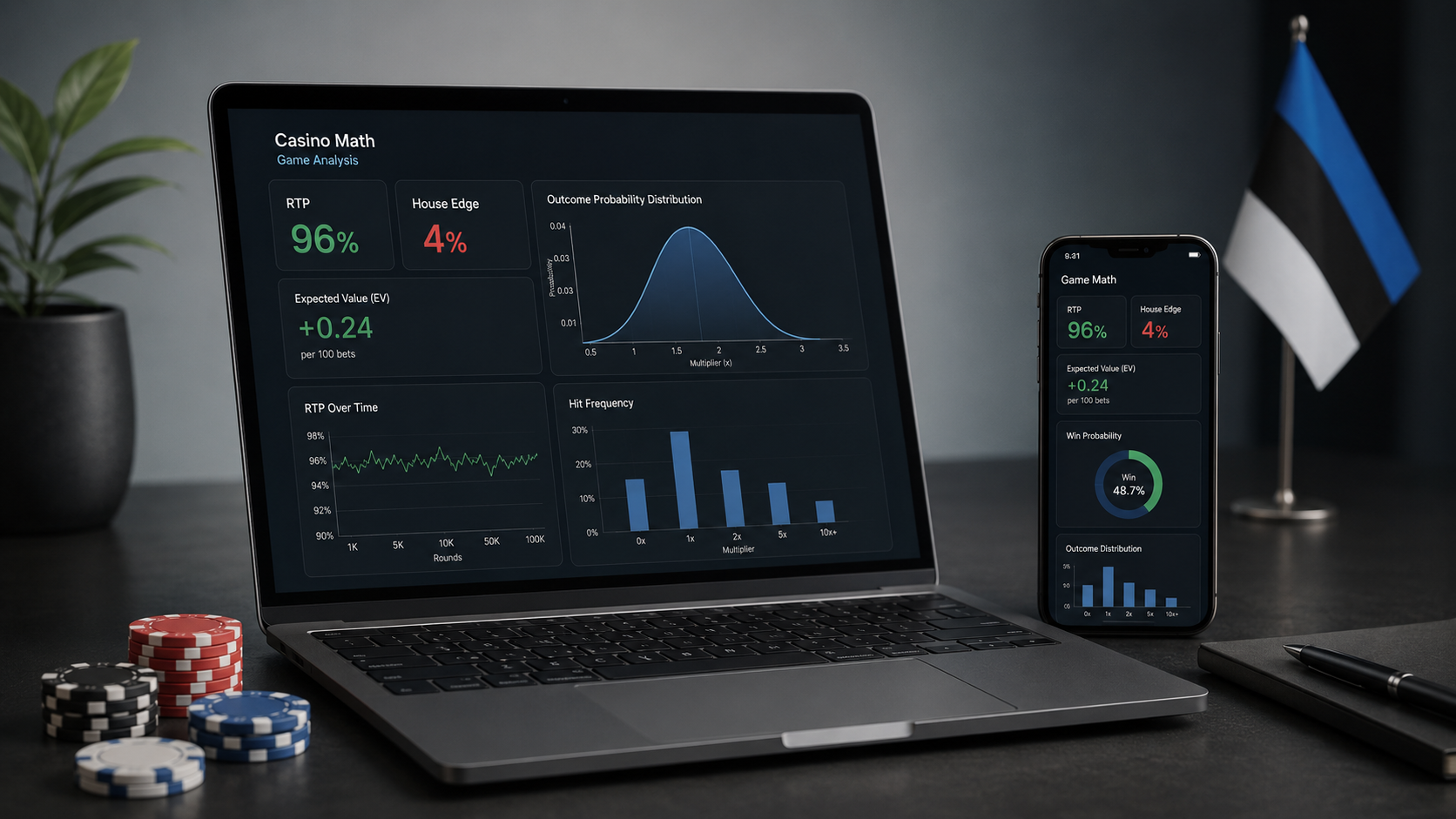
- RTP definition: Return to Player shows the mathematical share of the money staked that a game pays back to players over long-term statistics.
- The house edge: the casino's mathematical advantage over the player, found by the formula 100% - RTP. It ensures the operator always stays in profit in the long run.
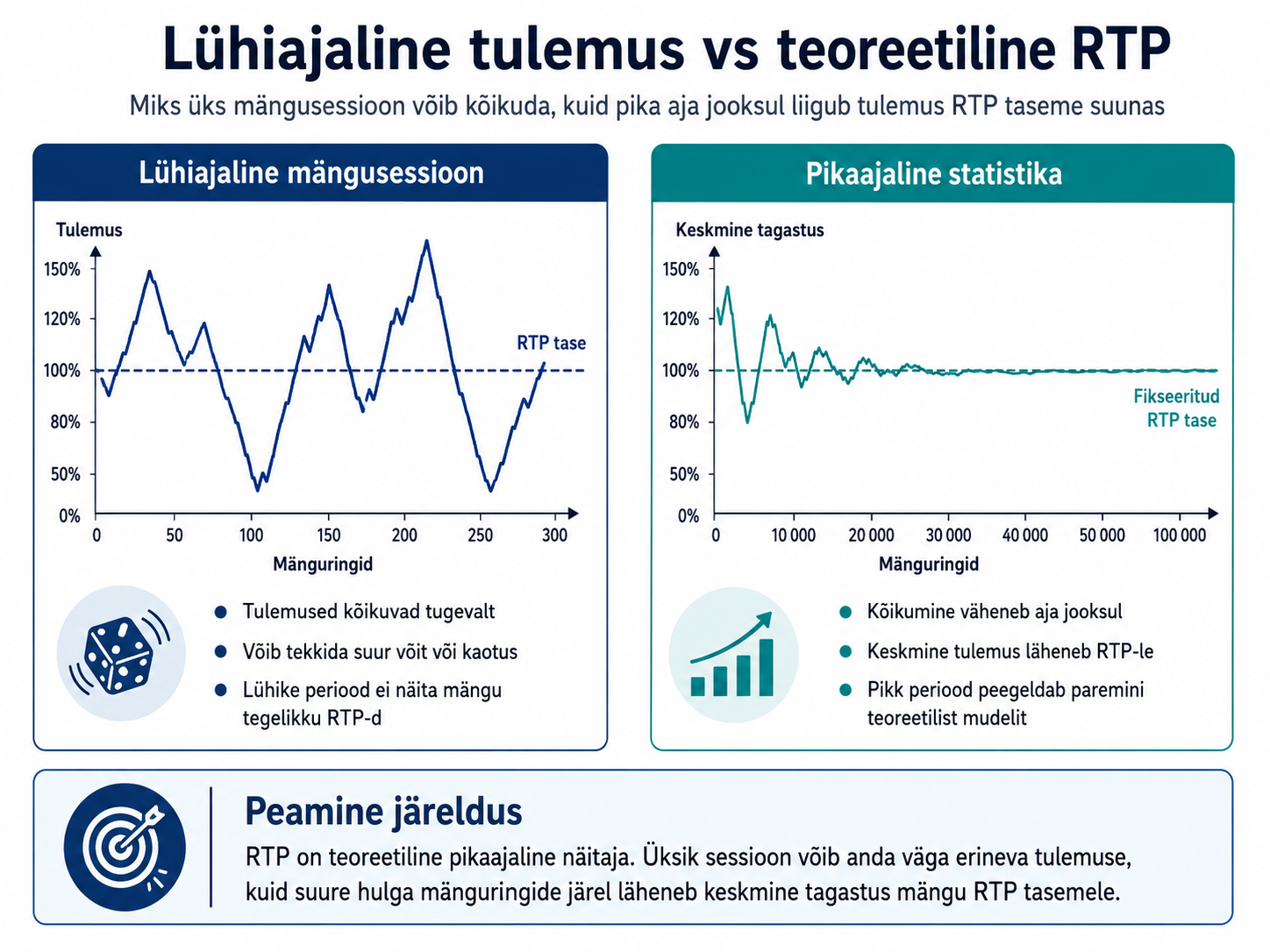
- RTP applies across millions of spins: a 96% RTP doesn't mean you'll definitely get 96 back from every 100 euros in one short session. It's the average result of billions of spins.
- Volatility sets the rhythm: high-volatility games pay rarely but large sums; low-volatility games offer stable smaller wins, keeping the balance even.
- Play on licensed sites: an EMTA licence guarantees that games' algorithms are checked and match the certified RTP without manipulation on the casino's part.
What is RTP and how does it theoretically work?
What is RTP?
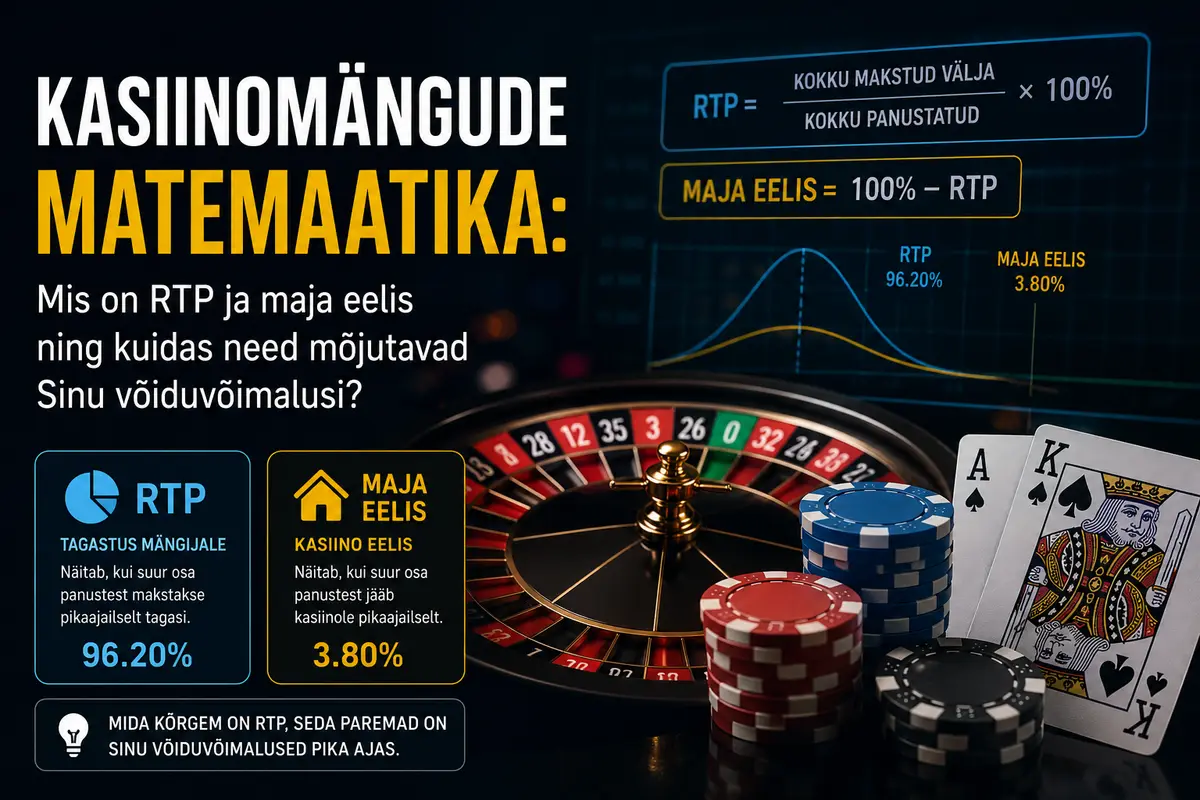
RTP (Return to Player) is a casino game's mathematical indicator that expresses the theoretical percentage of the collected bets that a given game pays back to players as winnings over long-term billions of spins or hands.
When we talk about terms like casino games, RTP is the foundation the whole system rests on. Imagine a specific slot's code has RTP 96% written into it. This means that if €10,000,000 is staked in this game globally by all the world's players combined, the algorithm returns €9,600,000 as winnings. The remaining €400,000 stays with the casino and the provider that created the game to cover costs and as pure profit.
At the player level it's critical to understand the words "theoretical" and "long-term". Many beginners, after the registration process, make a €100 deposit, choose a game with 97% RTP and get angry when they leave the computer with an empty balance. In the short term RTP means nothing, because the game's results are subject to randomness governed by the RNG (random number generator).
What is the house edge and why does the casino always win?
What is the house edge?
The house edge is the mathematical advantage that a game's rules or code give the online casino over the player, ensuring the operator a long-term guaranteed profit. It's calculated by subtracting a specific game's RTP value from 100 percent.
The old saying "the house always wins" is based not on magic and not on deception, but on pure mathematical design. The house edge is built into every game's rules — be it roulette, blackjack or the modern video slots offered by well-known game providers.
The house edge works even when you personally win millions with a giant jackpot. Your win is covered from the losses of thousands of other players who at the same time put money into the system. The casino doesn't need to manipulate the results — the mathematical structure of the rules provides them a stable passive income for as long as the reels spin and cards are dealt.
How are RTP and the house edge calculated?
To understand the system's depth, let's look at a classic mathematical model. The house edge and RTP are inversely related, and their sum is always 100%.
RTP + House edge = 100%
House edge = 100% - RTP
A practical example: European roulette
A European roulette wheel has 37 numbers: the numbers 1–36 (alternately red and black) and one green zero (0).
If you bet on one specific number, your winning probability is exactly 1 chance in 37. If you win, the casino pays you at a ratio of 35:1 (you get back your €1 bet and €35 of winnings, €36 in total).
Here's where the mathematical trick lies: on a win you're paid money as if there were 36 numbers on the table, but in reality there are 37. This one missing number (the green zero) generates the casino's profit.
House edge = 1/37 × 100% ≈ 2.70%
RTP = 100% - 2.70% = 97.30%
Volatility and variance: RTP's hidden twin brothers
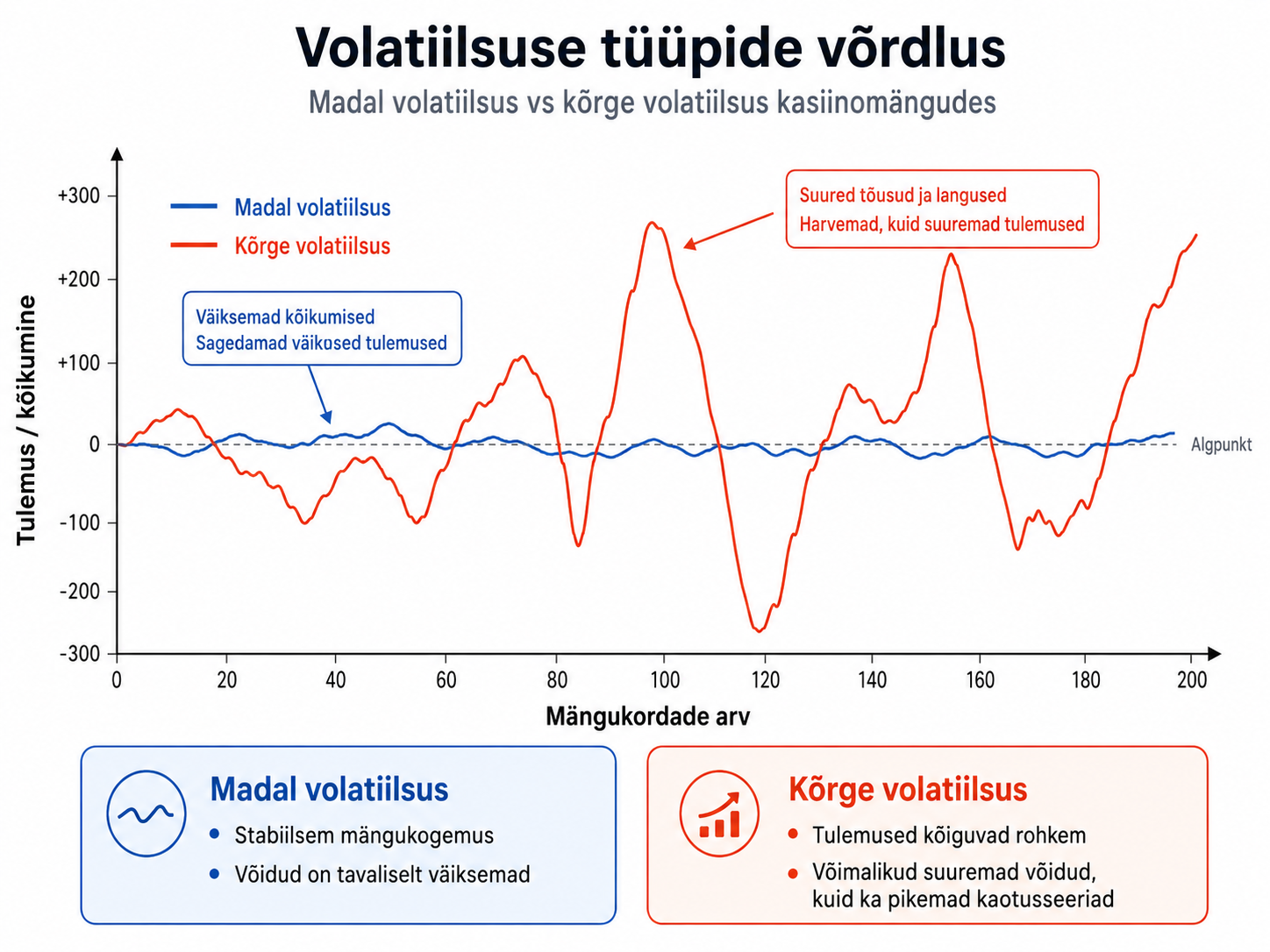
If two slot games have exactly the same RTP (for example 96%), in reality they can behave completely differently. The reason is volatility (in iGaming terminology also variance), which determines the rhythm and size of the winnings' distribution.
Low volatility
The game offers winning combinations very frequently, but the winning sums are tiny — often smaller than your original bet (e.g. you bet €1 and win €0.40). Such games keep your balance alive for a long time, offering stable entertainment, but you shouldn't expect giant jumps from there. This is ideal for wagering a casino bonus.
High volatility
The game works on an "all or nothing" principle. You can make 50 spins in a row without a single win, your balance melting like snow under the spring sun. But if the algorithm finally kicks in (for example through a special bonus game), it can spit out a win of 5,000 times or 10,000 times the bet. These games require a large stable budget and strong nerves.
Mathematical analysis and comparison of different casino games
Different types of casino games offer very different mathematical value. In the table below we've gathered the typical values of games available on Estonian markets. The lower the house edge, the greater your theoretical chances of surviving in the long run.
| Game type | Typical RTP range | Average house edge | Result determinant | Strategy's impact on result |
|---|---|---|---|---|
| Blackjack (classic) | 99.50% – 99.60% | 0.40% – 0.50% | Skill + Chance | Extremely high (basic strategy) |
| Video poker (Jacks or Better) | 99.54% | 0.46% | Skill + Chance | High (optimal holding) |
| Baccarat (bet on the Banker) | 98.94% | 1.06% | Pure chance | Zero (the choice is made before the cards) |
| European roulette | 97.30% | 2.70% | Pure chance | Zero (systems don't change probability) |
| Online slots (modern) | 94.00% – 97.50% | 2.50% – 6.00% | Pure chance | Zero (only bet adjustment) |
| American roulette | 94.74% | 5.26% | Pure chance | Zero (the double zero increases risk) |
Expert advice: choosing roulette tables
"If you want to bet on roulette, then never sit down at an American roulette table, whether it's virtual or in live-casino format. American roulette has, in addition to the ordinary zero, a double zero (00) too. This single extra symbol almost doubles the house edge from 2.70% to a full 5.26%, making your chances of winning mathematically drastically worse without any added value."
Step-by-step guide: how to find and check a game's RTP
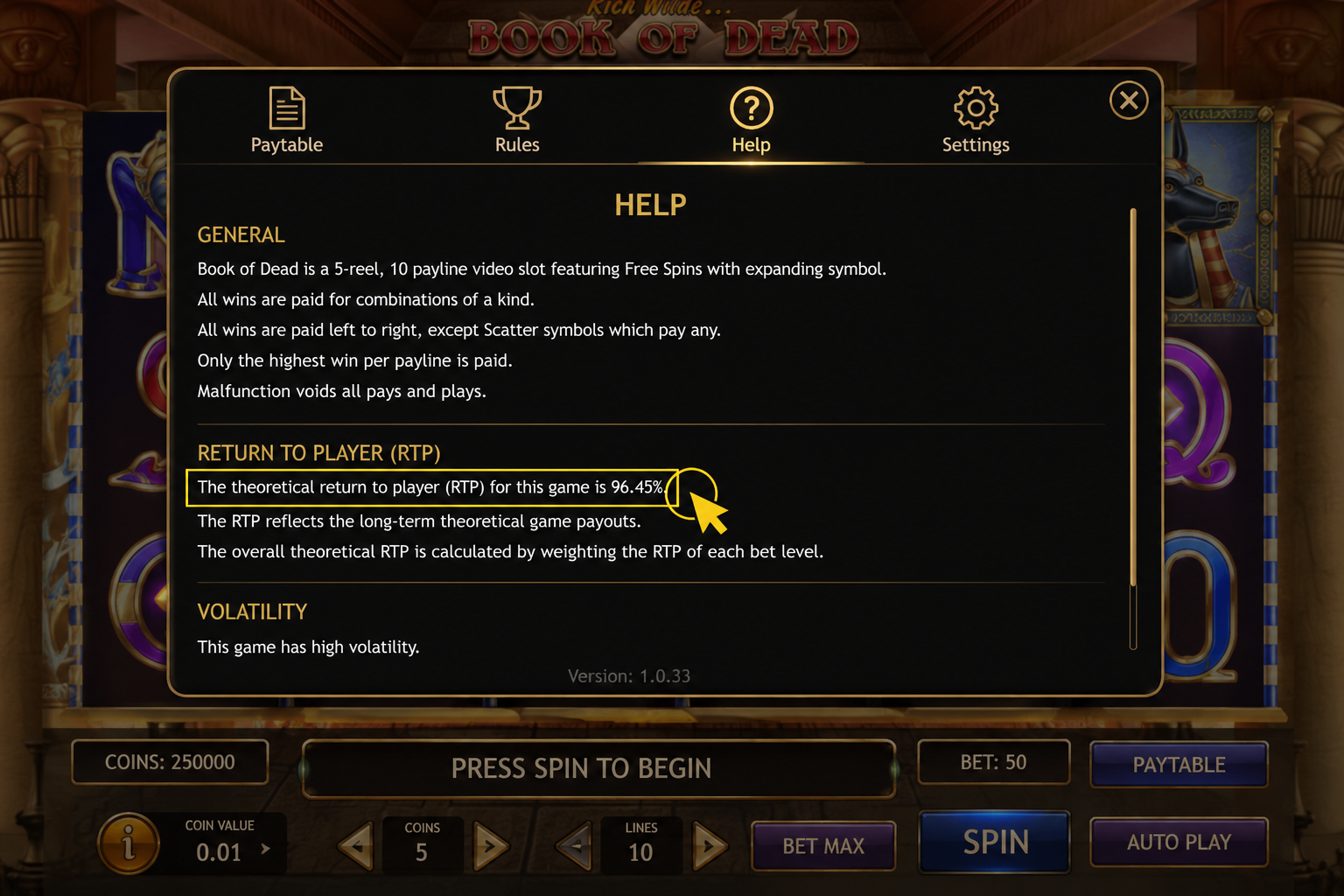
Nowadays a safe casino is obliged to ensure full transparency. You don't have to play blind — here's an exact guide on how to check a specific slot's return percentage before staking your real money.
A step-by-step action plan
- Log into your account: open your favourite Estonian online casino or enter a password-free fast-casino environment.
- Launch the desired game: open a slot game, for example in the free demo version or real-money mode.
- Look for the info icon: find a small button in the game's interface — usually it's marked with a
?(question mark),i(info) or three horizontal stripes (menu). - Open the game rules: click the button that opens a document titled "Game Rules".
- Scroll to the end of the text: the return percentage is almost always in the lower part of the text, in the chapter dealing with technical data and randomness.
- Check the number: look for the sentence: "The theoretical return to player (RTP) for this game is XX.XX%".
⚠️ Warning about flexible RTPs: in the modern iGaming world large game providers (such as Pragmatic Play or Play'n GO) offer casinos the option to choose between different RTP levels for the same game (e.g. 96%, 94% or even 91%). This means a slot called Book of Dead can have an excellent 96.21% setting in one Estonian casino, while in another portal it's turned down to 94.21%. Always check this indicator in each casino separately!
Casino bonuses and mathematical expected value (EV)
When a casino offers you an offer like a deposit bonus or free spins, it's possible to mathematically calculate whether the given offer is beneficial or harmful to you in the long run. This indicator is called expected value (EV).
A positive EV (+EV) means that mathematically you're in an advantageous position and the casino makes a loss in the long run by paying you. A negative EV (-EV) means that despite the extra money the house edge eats up the bonus's value before the wagering ends.
The formula for calculating a bonus's EV:
EV = Bonus amount - (Wagered volume × House edge)
A real example from life itself:
On registering a new account the casino offers €100 of bonus with a 35x wagering requirement on the bonus amount. You decide to wager the bonus on a slot whose RTP is 96.5% (i.e. the house edge is 100% - 96.5% = 3.5% ≈ 0.035).
- We calculate the required betting volume: €100 × 35 = €3500
- We calculate the theoretical loss due to the house edge: €3500 × 0.035 = €122.50
- We calculate the final expected value (EV): €100 - €122.50 = -€22.50
Expert conclusion: this specific bonus has a negative value (-€22.50). This means that statistically, in the course of wagering, you lose all your bonus money and, in addition, about €22.50 of your real money. Such a bonus is worth taking only to extend entertaining playing time, not for the purpose of earning money.
Licences and fairness audits: how does EMTA ensure fair algorithms?
One of the most common fears among beginners is: "But what if the online casino just changes the software settings and switches off winnings when I bet bigger?" On the regulated Estonian market such a scenario is technically and legally impossible.
Every operator wishing to offer a service must apply for a licence issued by the Tax and Customs Board. One of the strict conditions for obtaining an EMTA licence is that the casino's game servers and the games' code must pass a mandatory audit by independent international labs.
Which organisations check the games?
- eCOGRA: the world's leading independent testing agency, based in London, which audits iGaming systems, checking the RNG's fairness and the real return percentage.
- iTech Labs: a globally recognised lab that carries out certification of gambling software.
- GLI (Gaming Laboratories International): offers testing services to regulatory authorities and operators worldwide.
These labs carry out tests by making millions of test spins in the games' software and comparing the results with mathematical theory. Only when it's proven that the game's results are 100% unpredictable and match the declared RTP is the game given a certificate that admits it to the Estonian market.
Common mistakes and cognitive biases in casino-game maths
The human brain is evolutionarily adapted to seek patterns and connections where they don't actually exist. This produces dangerous cognitive biases and misconceptions in gambling that often lead to large monetary losses.
1. The Gambler's Fallacy
The belief that if some event has occurred more (or less) often than usual recently, then the probability of its recurrence changes in the future.
- Example: if red has come up five times in a row in roulette, many players are convinced that on the next round the probability of black coming up is much higher.
- The mathematical reality: a roulette wheel has no memory. The random number generator doesn't know what happened on the previous spin. The probability of red and black coming up is exactly the same on each independent spin (48.6% in European roulette).
2. The "hot" and "cold" machine myth
Players believe that a slot that hasn't given a single big win for a long time is "warm" and must spit out a large sum any moment. Or the opposite — if a machine just gave a big jackpot, then it's thought to be "cold" now and nothing will come from it.
- The mathematical reality: a slot machine's code generates results in real time. The probability of hitting a big win is exactly the same both a second before a big win and a second after it.
3. The Near-Miss Effect
A situation where two reels out of the three needed jackpot symbols are displayed on the screen and the third stops directly above the row. The player emotionally feels the win was "so close" and motivates themselves to keep playing.
- The mathematical reality: mathematically and algorithmically the win wasn't close. The RNG determined the result in advance, before the visual stopping of the reels. The "near-miss" is a graphic design created specifically to arouse gambling excitement in the player.
Pros and cons: preferring high-RTP games
High-RTP games (RTP 97%+)
- Pros:
- Your money is preserved substantially longer over the course of long play.
- An excellent solution for fulfilling a casino bonus wagering obligation.
- The casino's mathematical advantage over you is minimal.
- Cons:
- High-RTP games often have a lower maximum win potential (no mega-jackpots).
- Many Estonian online casino portals fully exclude these games when using bonus money.
Low-RTP games (RTP below 94% / progressive slots)
- Pros:
- They offer the chance to win life-changing millions of euros in a single second (e.g. the Mega Moolah series).
- They often contain more colourful and entertaining bonus games and effects.
- Cons:
- Your daily budget burns considerably faster.
- The mathematical expected value during an ordinary gaming session is low.
Frequently asked questions (FAQ)
What is RTP, i.e. the return-to-player percentage?
RTP (Return to Player) is a theoretical mathematical indicator showing how much of the total bets put into a game a specific casino game pays back to players as winnings over long-term billions of spins.
What is the house edge in an online casino?
The house edge (House Edge) is the casino's built-in mathematical advantage over the player, expressed as a percentage, showing how much of each bet remains as pure casino profit in the long run. It's found by the formula 100% - RTP.
Can an online casino change the RTP itself during a game?
A licensed Estonian online casino can't change or influence game results in real time. The games run straight on the software manufacturer's servers, and a strict audit checks them. However, some providers offer games in different fixed RTP versions that the casino can choose before putting the game up.
Does a 96% RTP mean I'll definitely get 96 euros back from every 100 euros?
No. This is the most common misconception. A 96% RTP is a theoretical average that forms over hundreds of millions of spins globally. Over one short evening your personal return can be 0% (you lose everything) or 5000% (you win big).
Which casino game has the smallest house edge?
Classic blackjack (played mathematically flawlessly by basic strategy) has the lowest house edge, in the range of 0.40% to 0.50%. This means this game's RTP is over 99.50%.
What is volatility and how does it differ from RTP?
RTP shows how much money a game pays back over a long time; while volatility (variance) determines how and with what rhythm these winnings are distributed (rarely and large, or often and in small amounts).
Why do progressive jackpot slots have a low RTP?
Because a certain share (usually from 1% to 5%) is taken from every bet made by a player and directed straight to the global mega-win fund. The game's ordinary base RTP is therefore lower (often around 88% - 92%), making it more costly for everyday reel-spinning.
How to find a slot game's official return percentage?
Launch the game and open its information window or rules menu (by pressing the ?, i button or the settings icon). The official documentation is, by law, obliged to contain a sentence about the theoretical return percentage.
What is the RNG and how is it connected to maths?
RNG (Random Number Generator) is a mathematical code that creates completely unpredictable and unique number sequences every millisecond. The RNG ensures that every game round is independent of previous ones and fair.
Can betting systems (e.g. Martingale) beat the house edge?
No. No betting system (doubling bets after a loss, etc.) is able to change the mathematical probability built into the game. Systems only change your short-term rhythm of winnings, but in the long run the house edge always prevails.
How does the Tax and Customs Board (EMTA) check the games' fairness?
EMTA requires legal operators to have official certificates from independent testing labs (such as eCOGRA or iTech Labs). These labs audit the games' algorithms and ensure the code meets the fairness requirements and the permitted RTP indicator.
How does a game's maths affect responsible gambling?
Understanding that all casino games have a built-in house edge and are designed to take money from the player in the long run helps to get rid of the illusion that a casino is a workplace or a source of income. This realisation is one of the most important psychological cornerstones of responsible gambling.
Related topics
Conclusion and the expert's final word
Entering the iGaming world without basic knowledge of maths is comparable to heading onto the financial market without knowing numbers. The return percentage (RTP) and the house edge are not merely dry lines in a casino's rules, but real mathematical forces that decide your long-term result. Understanding that every bet made contains a tiny "tax" in the casino's favour, you're able to free yourself from cognitive biases such as the Gambler's Fallacy or illusions about "hot" machines.
The art of successful and safe gambling lies in awareness. Always choose an Estonian online casino whose activity is regulated by the Tax and Customs Board, because this is the only guarantee that the displayed numbers and certified algorithms match the truth and your withdrawals are secured. When you use bonuses, always calculate their mathematical expected value (EV) and prefer low-volatility games to keep your balance stable. And most important — always treat gambling as paid entertainment, not as a way to earn money. No one can go against the maths, but a conscious player knows how to minimise risks and enjoy the game to the full by following the rules of maths.
Key takeaways: what RTP and house edge really mean for your odds
Strip away the neon glow of casino mathematics and you are left with two concepts that shape your long-term experience: RTP, the return-to-player percentage, and the house edge, the casino's built-in mathematical advantage. They are two sides of the same coin: the higher a slot or table game's stated RTP, the smaller the house edge, and vice versa. The single most important takeaway is that RTP is a statistical average that plays out over thousands and millions of spins, not over one evening or one session. This is exactly where most players go wrong: a high RTP does not guarantee a win tonight, it merely describes the theoretical long-run average across a very large number of rounds.
In practical terms, if you want the most playtime and entertainment for your budget, it makes sense to favour games with a higher return percentage and to check the RTP of each slot or table game before you start. In table games such as blackjack or certain video poker variants the house edge is often lower than in purely chance-based games, but there strategy and the decisions you make also affect the outcome. In roulette and slots, by contrast, the result rests entirely with the random number generator (RNG), and no betting system, stake-increasing strategy or myth of a "hot machine" will alter the long-run mathematics of the game.
The most common mistakes players make are chasing losses, confusing RTP with volatility, and believing that past outcomes influence the next spin. Volatility describes how large and how frequent the wins tend to be: a high-volatility slot pays out less often but in bigger amounts, while a low-volatility game pays more frequently but in smaller ones. RTP and volatility are separate measures, and both deserve attention in light of your budget and goals. So what should you do next? Set a clear budget and time limit before you play, choose games with transparent RTP figures, treat gambling as entertainment rather than a way to earn money, and never wager funds whose loss would threaten your financial wellbeing.
In Estonia, licensed casinos operate under a permit from the Tax and Customs Board (EMTA), play is restricted to those aged 21 and over, and responsible gambling remains every player's personal responsibility. If the game stops being fun, use self-exclusion and deposit or time limits and reach out to a trusted support service for help — always play in moderation and with a clear head.
Tools: the RTP calculator and the house edge concept.