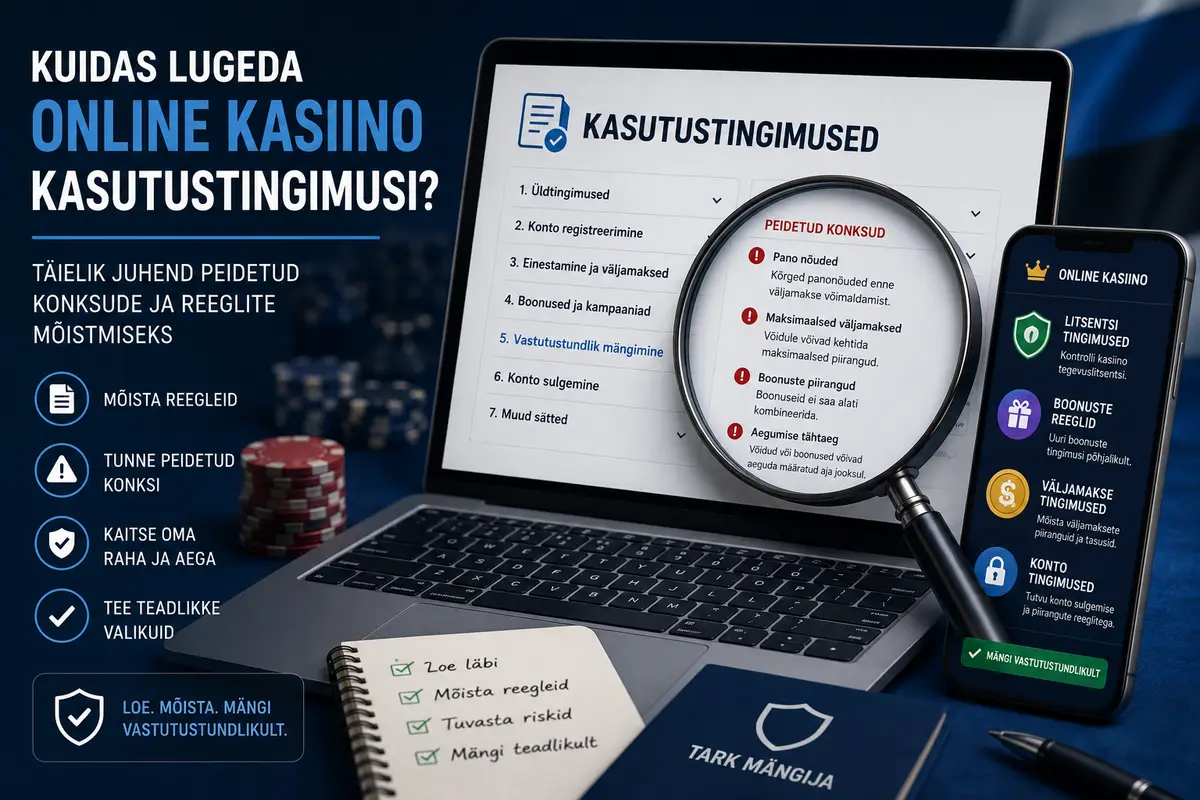
How to read an online casino's terms of use? A complete guide to understanding the hidden catches and rules
The digital gambling world in 2026 develops faster than ever. A modern Estonian online casino offers a user experience in seconds: a next-generation fast casino allows playing without…
The digital gambling world in 2026 develops faster than ever. A modern Estonian online casino offers a user experience in seconds: a next-generation fast casino allows playing without filling in long forms, where registration happens automatically during the first deposit. An enticing welcome bonus, hundreds of free spins and an exclusive deposit bonus are designed to capture players' attention. But have you ever thought about what you're actually signing when you tick the "I agree to the terms and conditions" button?
This detailed guide is created for Estonian players who want to navigate gambling platforms consciously, safely and avoiding legal traps. Most players ignore the terms and conditions (T&C), considering them boring legal text. But this is a critical mistake. A casino's rulebook is a binding contract between you and the operator. If the terms aren't read, your withdrawals may be unexpectedly voided, accounts blocked or winnings confiscated. From this article you'll learn how to read the terms like an experienced iGaming analyst, which points are of decisive importance and how to ensure the safe casino you've chosen acts entirely in your interests.
Quick summary
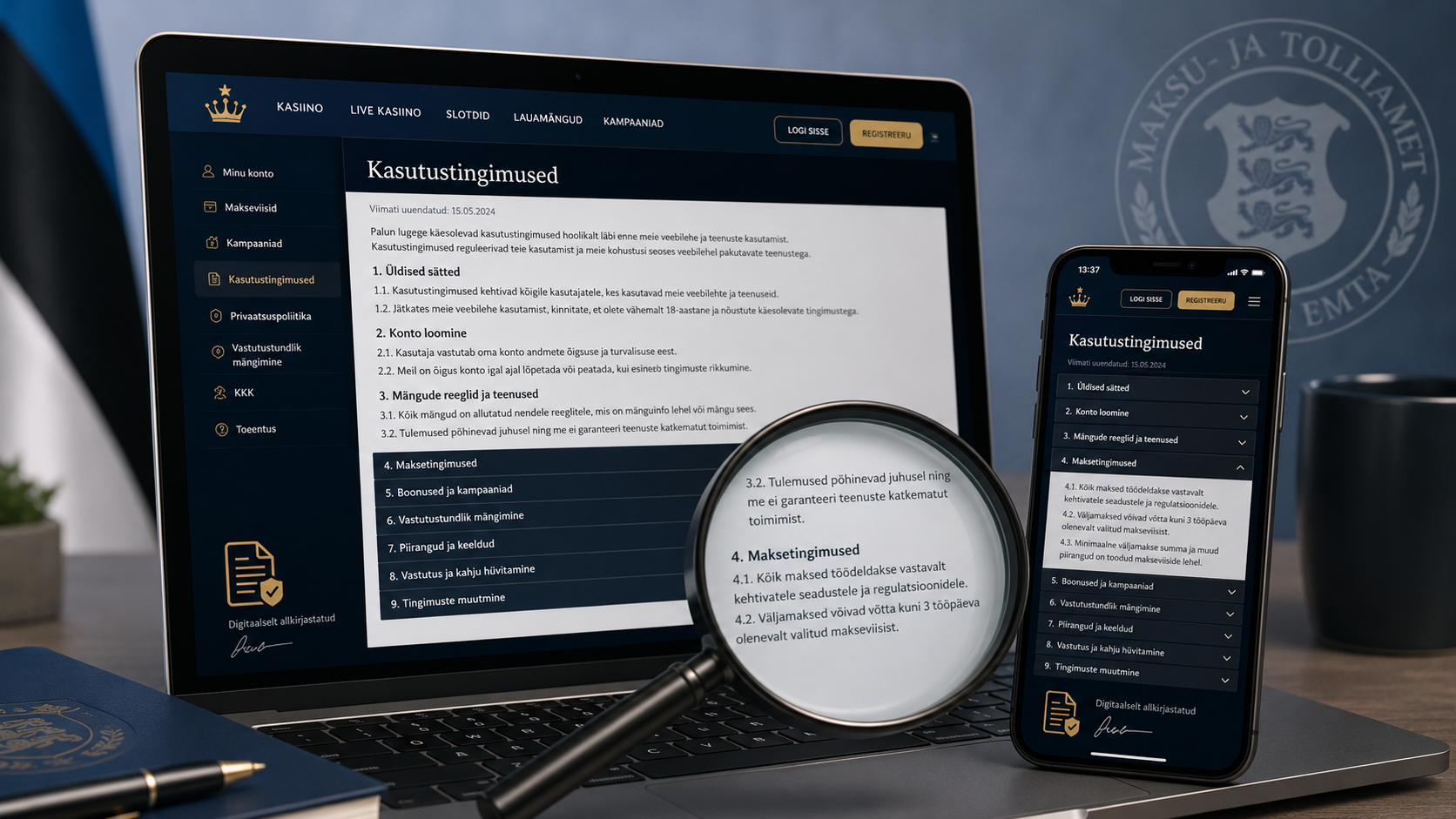
- A binding contract: the terms of use are legally binding. By agreeing to them, you give the casino the right to apply all the described sanctions if you break the rules.
- Bonus traps: the greatest dangers lie in wagering requirements (x30, x40 etc.), the maximum bet restriction (usually €5) and the list of forbidden games.
- KYC check: even if it's a registration-free fast-casino platform, the operator has the right to request additional documents before larger withdrawals.
- Withdrawal restrictions: the terms often state daily, weekly or monthly limits that govern how fast large wins reach your bank account.
- Legality: to ensure the terms are fair and comply with Estonian laws, play only at portals with a valid EMTA licence.
What are online-casino terms of use and why do they matter?
What are online-casino terms of use?
Online-casino terms of use (Terms and Conditions, i.e. T&C) are an official legal document defining the rules, obligations, restrictions and rights that govern the relationship between the player and the gambling operator. The player is obliged to agree to them when creating an account or making the first deposit.
In the iGaming industry, rules don't exist merely to fulfil bureaucracy. They protect the casino from fraud and money laundering, but at the same time define the framework within which the player may use their money. If the rules are ignored, the result is almost always to the player's detriment.
Imagine a situation: you've activated an enticing campaign offer, got free spins and won several thousand euros with them. When you go to the money withdrawal section, the casino voids your balance. The reason given is that you placed a bet in a game that was forbidden when playing with a bonus. Since you pressed the "I agree" button when joining, you have no legal basis to protest. Reading the terms is your best protective shield against such scenarios.
The legal foundation: the EMTA licence and the binding nature of the rules
The Estonian gambling market offers players high security, but only if the right platform is chosen. There's a drastic difference between playing on a regulated market and on offshore sites precisely in the interpretation of the rules.
The Tax and Customs Board's role in checking the terms
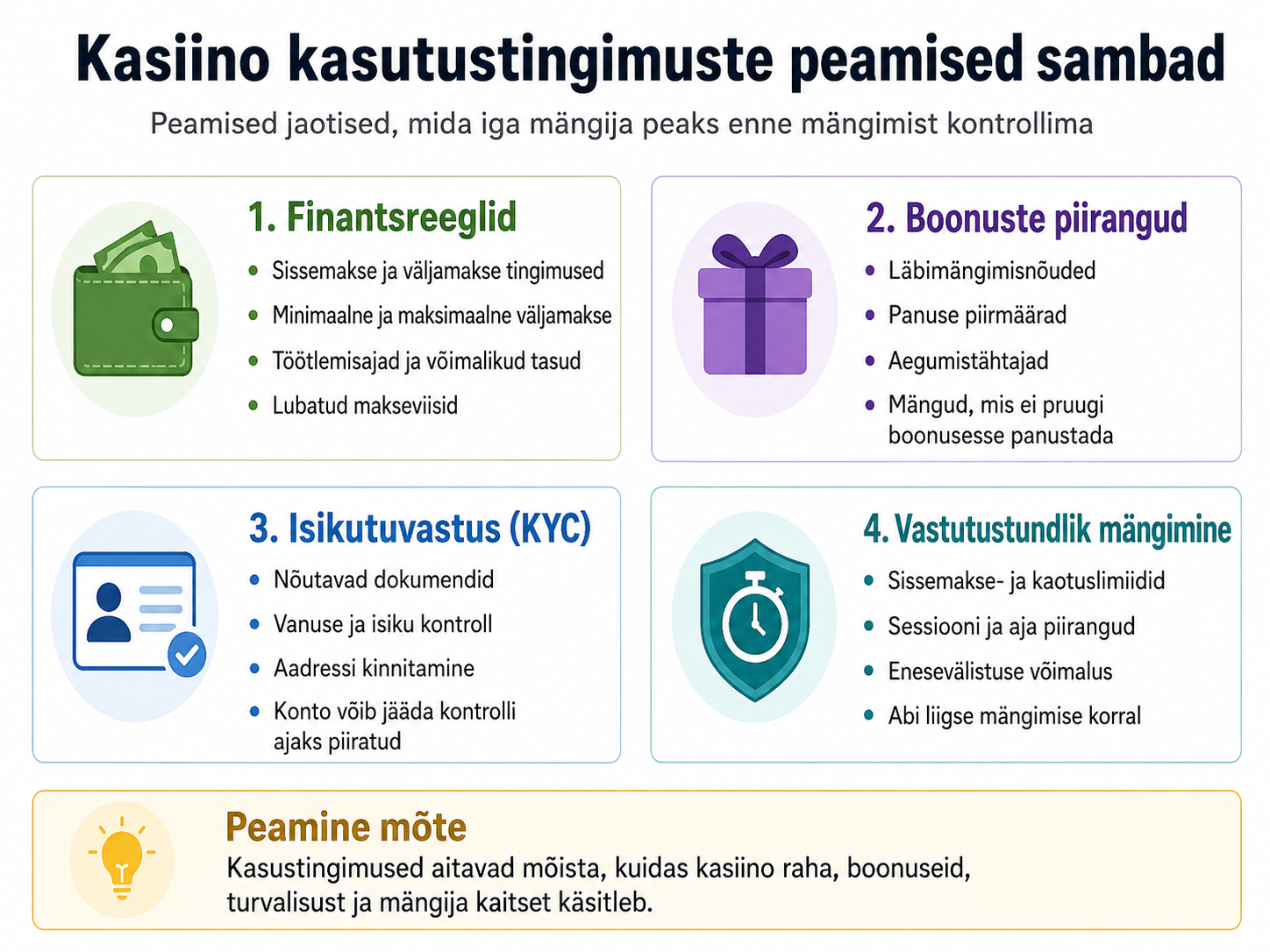
In Estonia operating licences are issued by the Tax and Customs Board (EMTA). If a website has a valid EMTA licence, it means state officials have reviewed the casino's general terms of use and made sure they contain no points conflicting with Estonian laws (for example unfair asset-confiscation terms).
- Licensed market: in case of disputes you have the right to turn to EMTA or the Consumer Protection and Technical Regulatory Authority (TTJA). The casino's terms of use must be available in correct Estonian.
- Unlicensed market (offshore): at casinos licensed in Curaçao or similar regions the terms are often written so that the operator has the right to close the account without any explanation. In such a situation it's essentially impossible for an Estonian player to defend their rights.
Account registration and identity verification (KYC rules)
Rules on the accuracy of personal data and account management form the first large block of T&C documents. Mistakes in this section can lead to a permanent account block.
The strict ban on duplicate accounts
One of the strictest rules at any online casino is: one account per person, household, IP address and device.
Warning: if you open a new account at a casino where you already have a forgotten login, or if a family member creates an account from the same computer to get the same welcome bonus, the system automatically flags it as a fraud attempt (bonus abuse). The casino has the right to close both accounts and void the winnings.
KYC (Know Your Customer), i.e. the identity-verification process
Many players think that when choosing a modern fast casino where registration happens through a bank link, submitting documents is a thing of the past. This is a myth. The terms of use always stipulate that the casino has a legal obligation (the anti-money-laundering law) to request additional documents:
- A photo of an ID-card or passport to establish identity.
- A utility bill or bank statement to prove place of residence.
- Proof of the source of funds (Source of Wealth) if your deposits exceed a certain threshold (usually from €2,000).
Financial terms: withdrawals, limits and money withdrawal
The finance department's rules determine how and when you get your money. This is the section where several hidden costs and time delays lurk.
Mandatory wagering of deposits
One of the most common surprises for beginners is the rule that all deposited money must be wagered at least once (1x) before a withdrawal. If you deposit €100 and decide to withdraw without placing a single bet, the system will reject it or apply the administrative fee stated in the terms (usually 5–10%). This rule is set to prevent money laundering.
Withdrawal limits and processing times
The terms always state minimum and maximum withdrawals. Although fast casinos process transactions in real time, many traditional platforms limit the amount withdrawn per day or month.
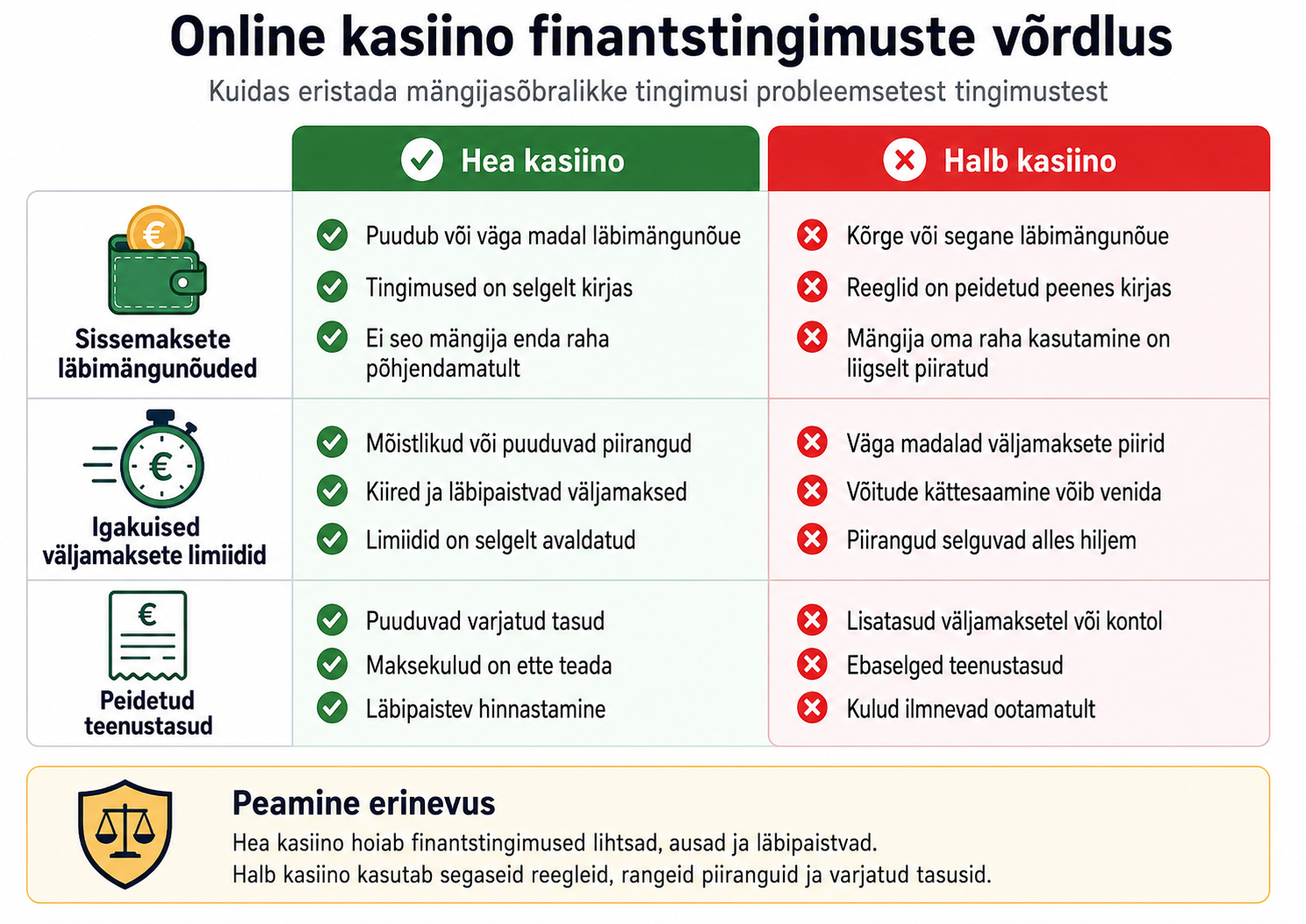
A typical financial-terms comparison table
| Rule type | A player-friendly term | A warning sign in the terms | Why does it matter? |
|---|---|---|---|
| Deposit wagering | 1x wagering on slots. | 3x–5x wagering on real money. | Determines whether you can freely withdraw the money you deposited. |
| Monthly withdrawal limits | No limits or very high ones (e.g. €50,000+). | Low limits (e.g. only €5,000 a month). | With a big win, getting the money takes months or years. |
| Transaction fees | All withdrawals and deposits are free. | Fees from the third withdrawal a week (e.g. €2 per transaction). | In the long run affects your gambling budget and profitability. |
The fine print of bonuses: casino bonus, free spins and wagering requirements
Bonus Terms are the area where the most mistakes are made. Casinos create a separate bonus-rules page that's a binding addition to the general terms.
Calculating the wagering requirement
If you have a deposit bonus, a wagering requirement almost always applies to it. But there's a big difference in the terms in how it's calculated:
- Bonus money only (B): you got a €10 bonus with 30x wagering. You must bet 10 × 30 = €300.
- Deposit + bonus (D + B): I deposited €10 and got a €10 bonus with 30x wagering. I must bet (10 + 10) × 30 = €600. This doubles your obligation!
Maximum bet restriction (Max Bet)
Almost every casino bonus comes with a rule limiting the maximum bet per spin or round. On the Estonian market this limit is as a rule €5.
Expert tip: if during bonus wagering you make even one €5.50 spin (even accidentally), the system counts it as a breach of the terms. The casino's automated software detects it at the withdrawal request and voids your entire win amount.
Game restrictions: forbidden casino games and betting rules
Not all casino games count toward completing a bonus equally. This is a hidden point that many players don't notice.
Forbidden slots and low-bet games
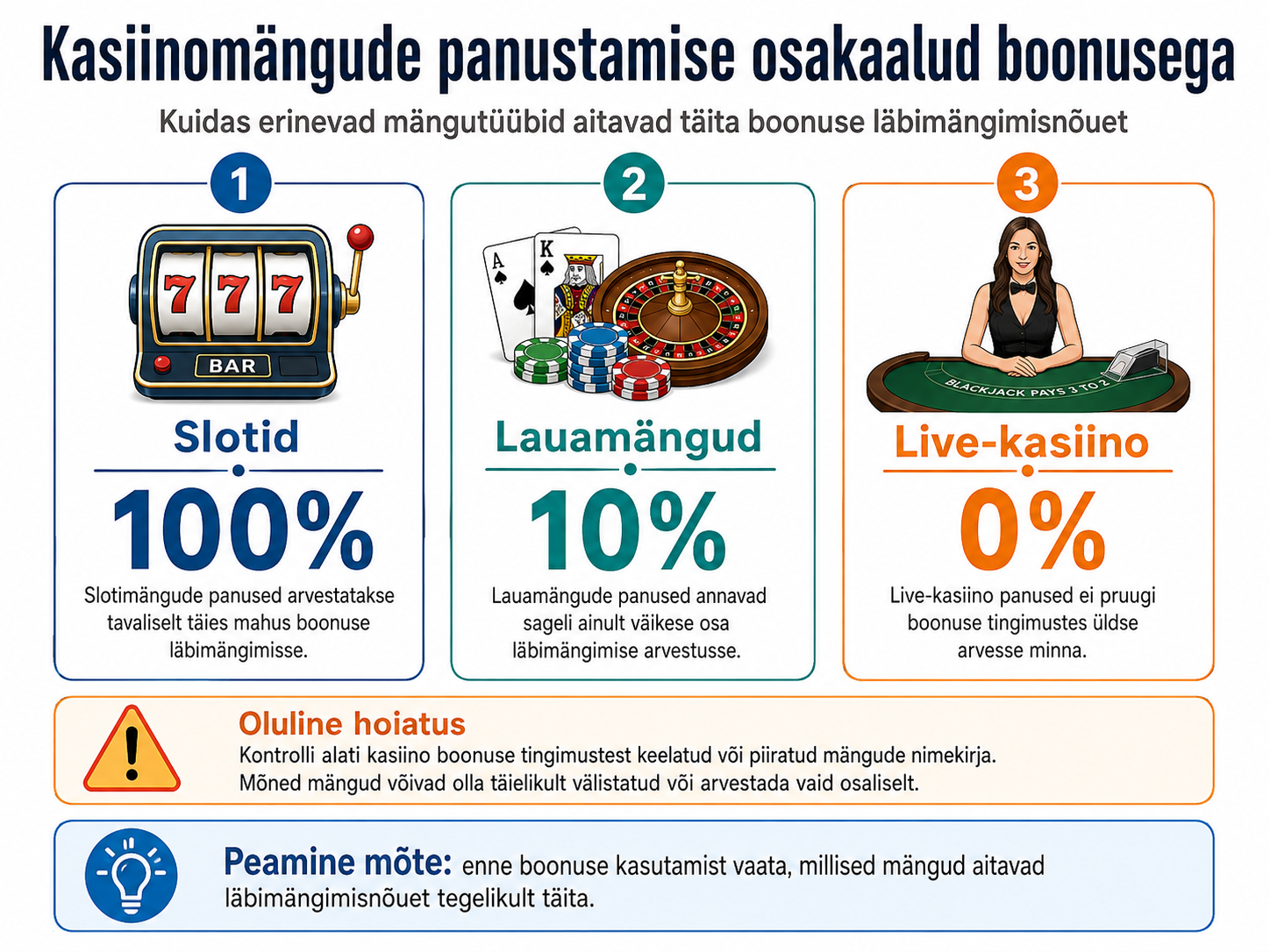
Casinos exclude high-return-percentage (RTP) games or those with collection mechanics from bonus wagering (for example Blood Suckers, Dead or Alive or slots from certain mega-popular game providers). If you open a forbidden game while you have an active bonus, you clash with the rules.
Game betting weights (Game Weighting)
The terms always have a special section showing as a percentage how much a game type contributes to the wagering requirements:
- Slot machines: usually 100% (every €1 wagered reduces the requirement by €1).
- Live casino and table games (blackjack, roulette): often only 10% or 0% (you bet €1 but only €0.10 or nothing counts).
Responsible gambling and account closure in the terms
A good and safe casino also clearly defines in the terms of use the player's rights to self-protection and describes the procedures that apply when suspending an account.
The legal consequences of self-exclusion
The responsible gambling section stipulates how the casino behaves when a player asks to close their account due to a gambling problem. The terms must state:
- Restrictions must apply immediately after the player has confirmed the choice in the account settings.
- The casino is strictly forbidden to send marketing materials (offers, free spins in newsletters) to people who have excluded themselves.
- If the player enters themselves in the state list, a centralised block managed by the Tax and Customs Board applies across all platforms.
Step-by-step guide: how to check the T&C text in 5 minutes
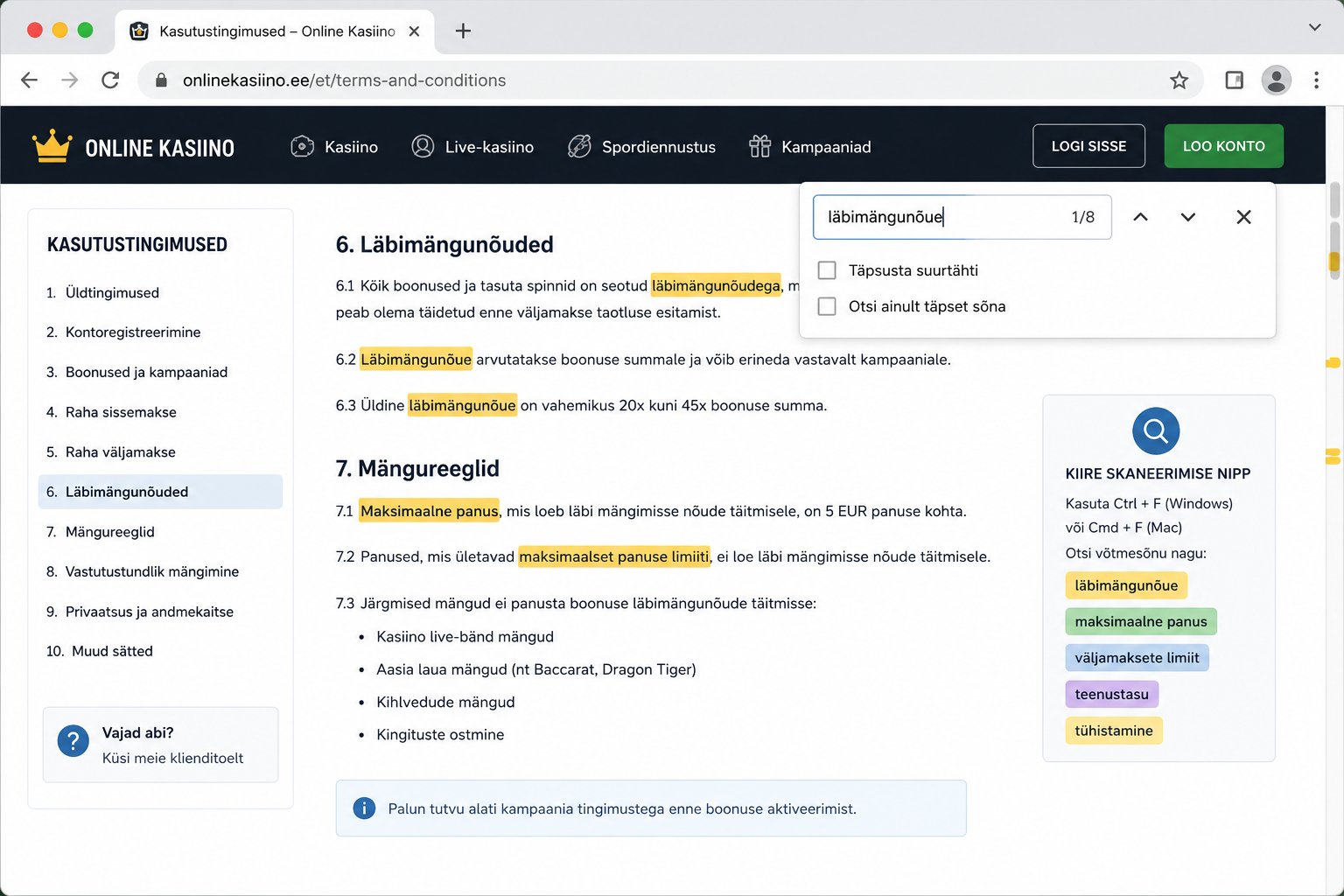
Reading such a long text may seem intimidating. But iGaming experts never read the whole text word for word — they use a targeted search.
- Open the terms-of-use page: step 1.
Go to the site footer and click the "Terms of use" or "Terms and Conditions" link.
- Use the search function (Ctrl + F): step 2.
Press Ctrl + F on the keyboard (Cmd + F on a Mac) to open the browser's search bar.
- Search for financial keywords: step 3.
Enter words like "withdrawal", "limit", "fee" or "wagering" into the search. Check whether a mandatory wagering requirement applies to real money and what the maximum monthly restrictions are.
- Check the bonus fine print: step 4.
Open the separate bonus-terms page and search for the keywords "maximum bet", "maximum win" (max cashout) and "forbidden". This takes only a moment but saves you from voided winnings.
- Make sure the licence is valid: step 5.
Make sure the text clearly mentions the company's registration number and a valid Estonian EMTA licence.
Common mistakes players make by ignoring the terms
Over my long career as an iGaming analyst I've seen hundreds of cases where players lose the right to winnings over completely trivial errors.
- "Support allowed it, so it's OK": a big mistake is to trust a support-chat agent's statement if it contradicts the official T&C text. The terms of use always have a clause: "Written or verbal statements have no legal force over these terms."
- Using a VPN, i.e. a location changer: if you try to enter a casino via VPN to play geo-blocked casino games or providers' products, the system detects it during the security check. Using a VPN is strictly forbidden at almost all Estonian-licensed casinos and leads to permanent account closure.
Pros and cons: fast casinos vs. traditional rules
Different types of online casino apply different legal and operational strategies in their terms of use.
Fast-casino (Pay N Play) rules
- Pros: the financial part of the terms is significantly shorter and clearer. There are no long clauses about account-confirmation documents in the first phase, since the data comes straight from the bank. Bonuses are often simpler (e.g. free spins with no wagering).
- Cons: very little flexibility in payment methods — the rules allow transactions only through one specific personal bank account.
Traditional online-casino rules
- Pros: the rules allow using a wide selection of payment methods (credit cards, e-wallets like Skrill and Neteller). Greater opportunities to negotiate personal VIP terms.
- Cons: massive T&C texts where bonus rules, general rules and the privacy policy are spread across different pages, making it hard to find hidden catches.
Frequently asked questions (FAQ)
What is the most important point in an online casino's terms of use?
The most important point is the bonus wagering terms and the financial withdrawal limits. They directly determine how easily and in what amount you actually get your won money out of the casino.
Does the casino have the right to change the terms of use without notifying me?
Yes, most casinos state in the terms that they have the right to change the rules at any time. But the good practices of an Estonian online casino and the licence terms require that the player is notified of significant changes (e.g. a change in the withdrawal procedure) at login via a separate pop-up window.
What happens if I accidentally break the maximum bet rule?
If, while playing with a bonus, you place a bet larger than allowed (e.g. €5), your casino bonus and all winnings earned with it are voided. The systems automatically check the betting history before approving a withdrawal, so "accidentally" doesn't count as an excuse.
Are fast-casino terms milder than at an ordinary casino?
Regarding financial transactions and registration, fast-casino rules are indeed much simpler and more customer-friendly. But the rules on campaigns, bet restrictions and responsible gambling are exactly as strict as on traditional platforms.
What does "bonus abuse" mean in the terms?
It's a broad concept covering actions like creating duplicate accounts to get bonuses multiple times, using betting patterns to minimise risk (e.g. betting on both red and black in roulette at once) or "saving" an in-game bonus round for a time when the bonus has already expired.
Can I take the casino to court if they refuse a withdrawal?
If you play on a platform with an EMTA licence, you have the right to file an official complaint with the Tax and Customs Board or Consumer Protection. If the casino has breached its own terms of use, the state will force it to pay out the money. In the case of foreign (offshore) casinos the legal route is practically fruitless.
Why does the casino require my utility bill if I deposited from a bank?
A utility bill is the international standard for Proof of Address. It's required during the KYC (identity verification) process to make sure you're really an Estonian resident and not playing from a region where gambling is forbidden by law.
Do wagering requirements always apply to free-spin winnings?
Not always. Some top-tier Estonian online casinos offer free spins with no wagering requirement as campaigns. In that case the winnings immediately become your real money. But in most cases spin winnings must be wagered again the number of times stated in the terms (e.g. 30x).
Can the casino close my account without giving a reason?
The general terms almost always have a clause allowing the operator to end the business relationship and close the account at its discretion. But on licensed markets a rule applies: if no fraud is detected on your part, the casino is obliged to fully return the real-money balance on your account.
What is an "inactivity fee"?
If you don't log in to your account for a long time (usually 12 consecutive months), the account is considered inactive. Under the terms, the casino has the right to start deducting a monthly maintenance fee (usually €5 a month) from your account balance until the account is empty.
Related topics
Conclusion and the expert's final word
Understanding an online casino's terms of use is the foundation of a successful and stress-free gaming experience. In the digital age, where casino games are available on any device and creating a new account takes only a moment thanks to fast-casino technology, it's easy to forget that gambling comes with strict legal frameworks. The terms don't exist to torment you but to establish rules that ensure the fairness of the environment for both parties.
The most important lesson is awareness. Before making your first deposit and activating a grand offer like a welcome bonus or free spins, take five minutes for the quick scan described in our guide. Find the maximum bet restrictions, the wagering multipliers and check what the withdrawal limits are. This preventive action avoids disappointments and ensures that if luck smiles on you and you win a life-changing sum, the money withdrawal goes fast and without problems.
Always play at portals holding an official EMTA licence, because only that way are you protected by the laws of the Republic of Estonia and can be sure the terms are fair. Treat gambling as entertainment, follow the rules and adhere to responsible gambling principles. Knowledge is your greatest ally in the iGaming world — use it wisely!
Key takeaways: how to read online casino terms and conditions
Reading online casino terms and conditions is a skill that separates the experienced player from the casual chancer, and this guide has shown that most unpleasant surprises hide precisely in the fine print that hardly anyone bothers to open. The most important takeaway is simple: before you make your first deposit or activate a bonus, read at least three sections — the bonus terms, the withdrawal rules, and the account requirements. These are where the hooks usually lurk, the ones that quietly slip past you in a moment of optimism. Terms and conditions are not designed to be hostile toward you; they legally define what is allowed and what is not, so it is worth treating them like a map of unfamiliar terrain.
The most common mistake players make is ignoring the wagering requirement. If a bonus carries a high wagering requirement, it means the amount you win cannot be withdrawn immediately but must be played through repeatedly. A second recurring stumbling block is the maximum bet limit while a bonus is active, along with game weighting, since not all slots and table games contribute to the wagering requirement equally. A third hidden rule concerns account verification: many fast casino users only discover at the moment of withdrawal that they are asked for an identity document, which is a perfectly normal part of the KYC process and tied to anti-money-laundering requirements.
What should you do next? A practical recommendation is to record every deposit and bonus activation you make, and to check the conditions beforehand rather than afterward. Search the terms for keywords such as wagering requirement, withdrawal limit, expiry date, and excluded countries. Pay attention also to whether the terms and conditions are available in a language you understand clearly, because a comprehensible text reduces the risk of misinterpretation. If anything remains unclear, contact customer support and keep the conversation as evidence.
In the Estonian context it is important to remember that a legally operating online casino must hold a licence issued by the Tax and Customs Board (EMTA), which ensures the conditions comply with local requirements and that player protection is regulated. A licensed operator's terms are more transparent and its payouts more reliable. Finally, a brief reminder about responsible gambling: gambling is permitted only for those aged 21 and over, it should remain entertainment rather than a source of income, and if you feel you are losing control, use self-exclusion and limit tools and reach out to a helpline for support. Always read the terms, play consciously, and set yourself clear boundaries.