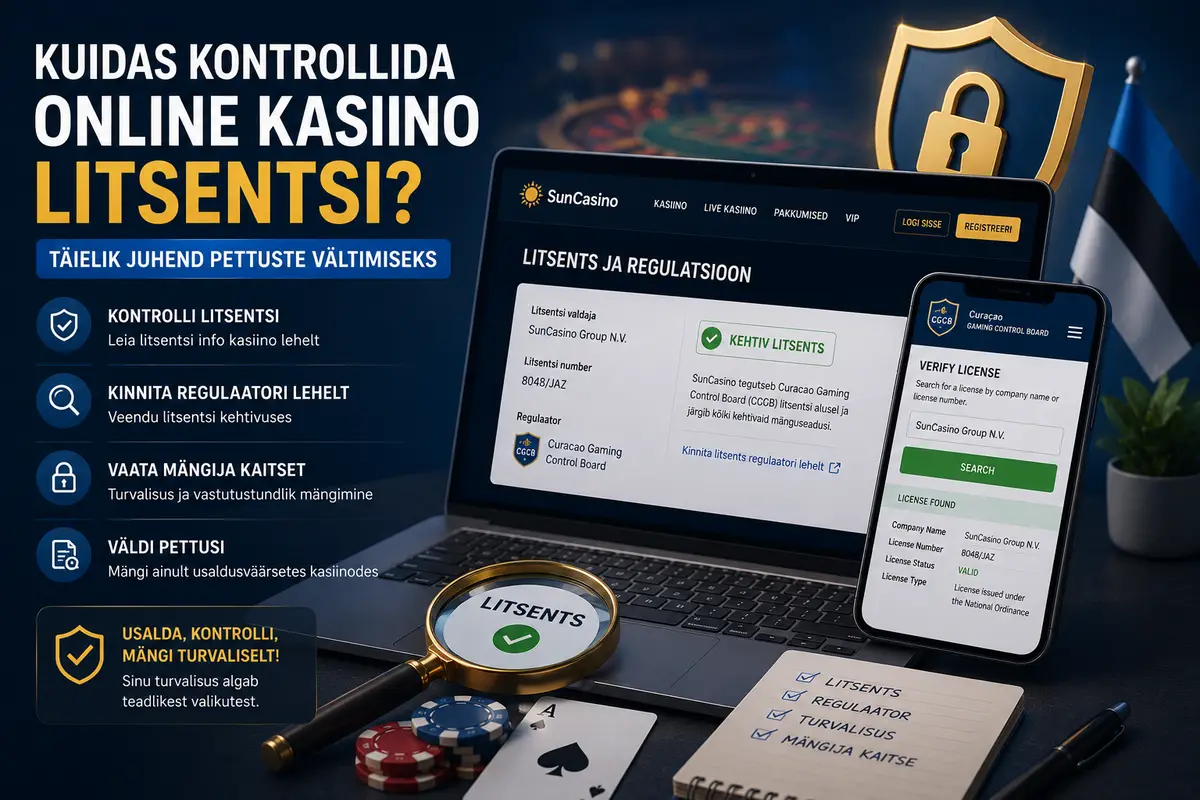
How to check an online casino's licence? A complete guide to avoiding fraud
The world of digital gambling in 2026 develops at a furious pace. A modern Estonian online casino offers players entertainment within seconds: a one-click welcome bonus, …
The world of digital gambling in 2026 develops at a furious pace. A modern Estonian online casino offers players entertainment within seconds: a one-click welcome bonus, hundreds of free spins and innovative account-free platforms, i.e. fast-casino solutions, have made playing easier than ever. But behind this wave of convenience lurks a serious risk. The internet is full of illegal websites that copy the design of well-known brands, offer fake games and hunt the personal data and financial funds of unsuspecting players.
How do you know your chosen place to play is genuinely a safe casino? The answer is simple but critical: you need to check its official operating licence. A licence isn't just a legal scrap of paper at the bottom of the site — it's the only guarantee that your withdrawals will actually be paid out, that campaigns (such as a deposit bonus) are fair and that your rights are protected at state level.
This detailed guide is written specifically for Estonian players, whether you're a complete beginner or an experienced remote-gambling veteran. Here you'll learn exactly how to identify an official licence, how the Estonian Tax and Customs Board (EMTA) supervision works, what the differences are between local and foreign licences and how to avoid fraudulent operators in just a couple of minutes.
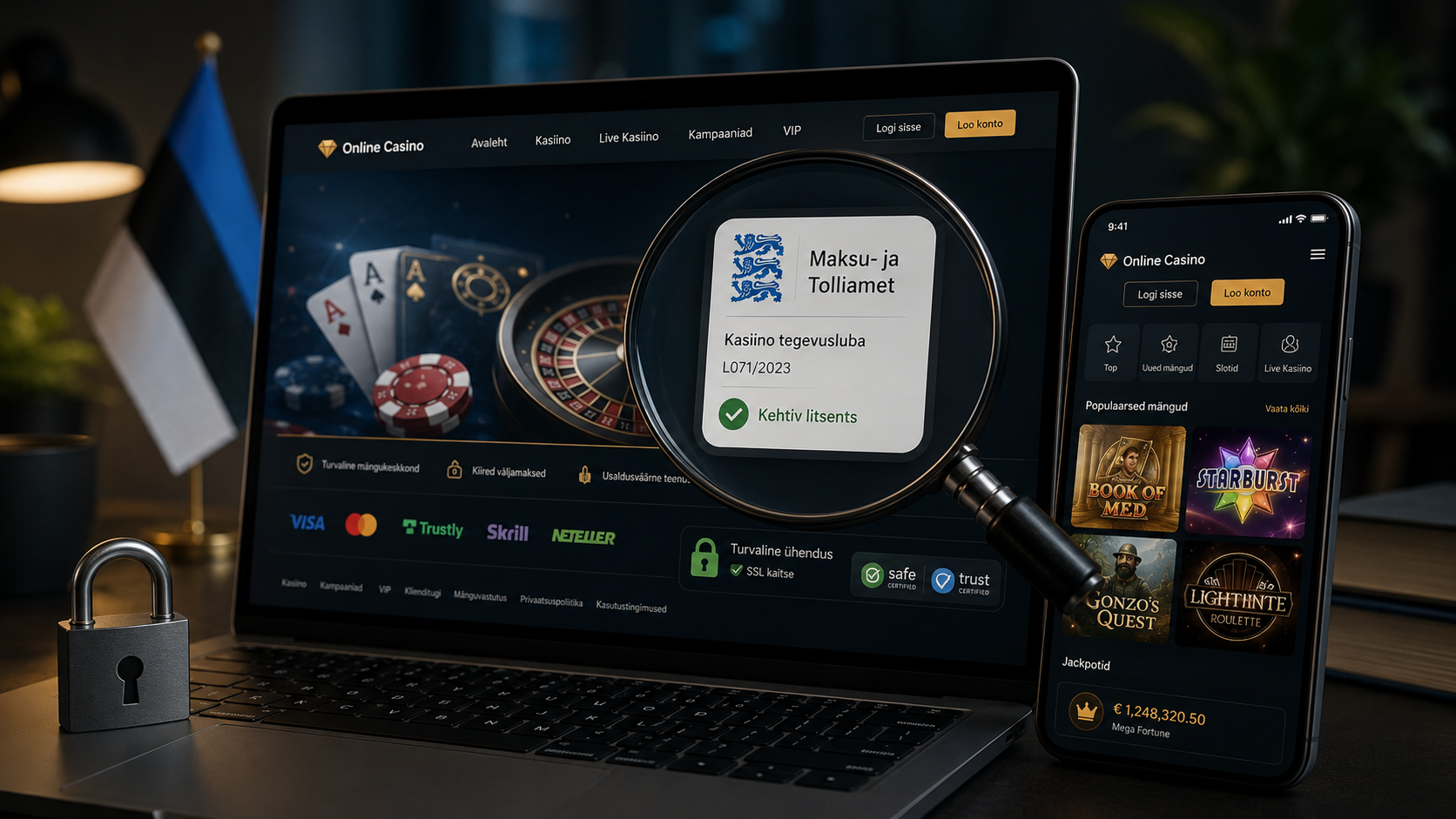
Quick summary
- The only certainty: in Estonia only those gambling portals that have been issued an official EMTA licence are legal.
- Check the footer: in the very bottom part of an honest casino's website, i.e. the footer, you'll always find the legal entity's details and the operating-licence numbers (e.g. HKT000000).
- Verify from the database: don't blindly trust the text on the site. Check the licence's validity directly in the Tax and Customs Board's official public register.
- Tax-free winnings: withdrawals from Estonian-licensed platforms are fully income-tax-free for the player. In the case of foreign (MGA, Curaçao) licences you must declare winnings yourself and pay income tax.
- Game control: a licensed mobile casino or computer version uses only audited software — this means the casino games and their algorithm are protected against manipulation.
What is an online-casino licence and why is it vital for the player?
What is an online-casino licence?
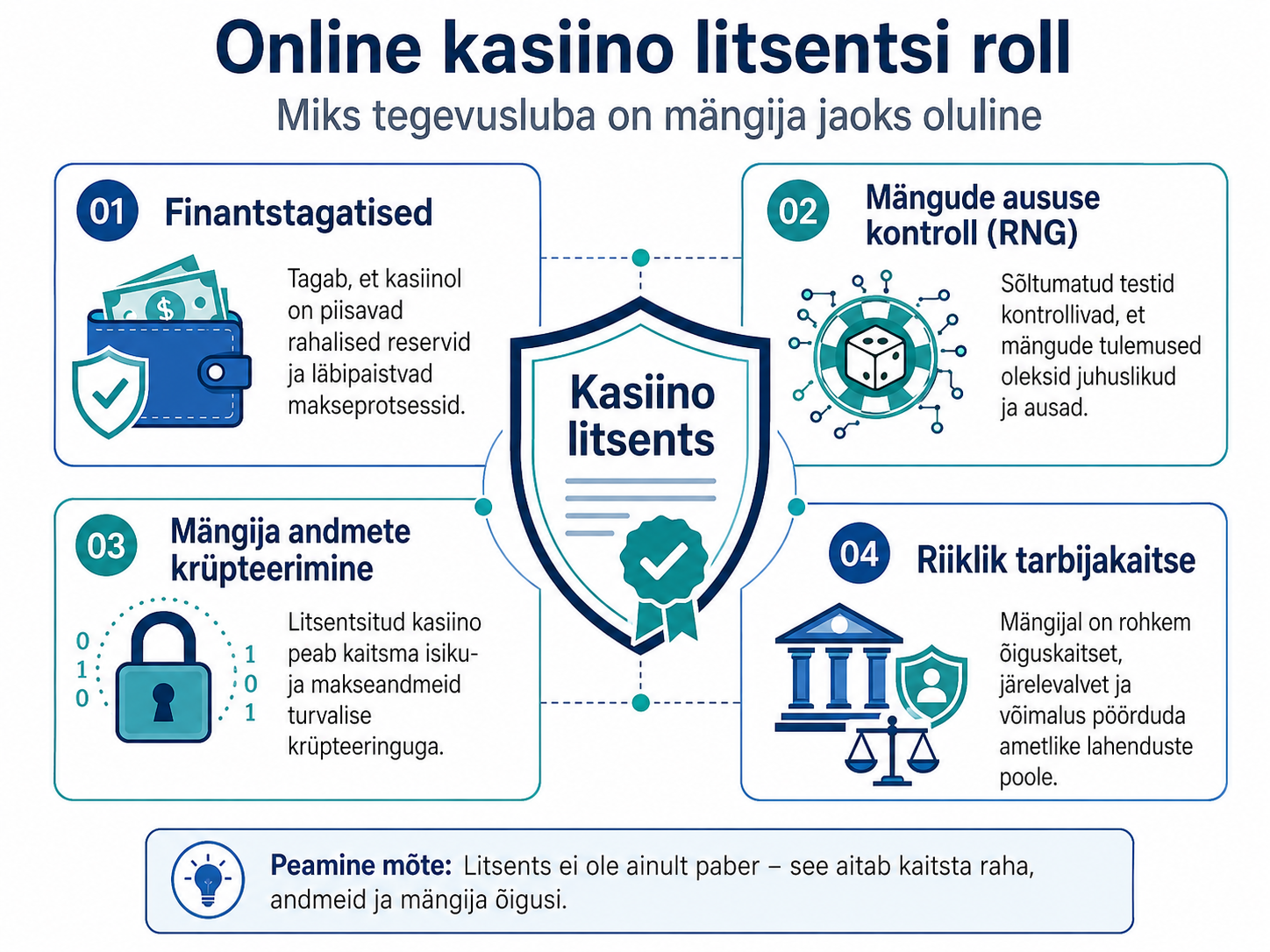
An online-casino licence is an official operating permit issued by a state or international authority, confirming that a gambling operator fully complies with the laws, has passed strict background checks and is obliged to ensure the protection of players' funds, fair software and responsible behaviour.
Gambling is by its nature a high-risk financial activity. A casino operating without a licence is essentially an anarchist website: if they decide to close your account or simply void a money withdrawal from a win, you have no legal basis whatsoever to reclaim your funds.
A licence ensures there's always an impartial judge, i.e. a state regulator, between operator and player. The regulator ensures the casino has enough capital to pay out all jackpots and big wins, that registration of personal data happens encrypted and that the live casino or slots aren't unfairly rigged in the operator's favour.
The legal framework in Estonia: what is an EMTA licence?
Estonia is one of Europe's most advanced countries in regulating remote gambling. Since 2010 the state has applied a system that ensures local residents maximum safety.
The Tax and Customs Board's role and requirements
In Estonia the Tax and Customs Board supervises gambling and issues operating licences. For one Estonian online casino to obtain the coveted licence, it must go through a two-stage process:
- Organising licence: proves the company's reliability, financial stability and clean management background.
- Operating licence: grants the specific right to open a remote-gambling website.
If a casino has an EMTA licence, it must also be connected to the Estonian central self-exclusion register system (HAMPI). This means that if a player feels gambling is becoming a problem, they can block themselves at all licensed Estonian casinos at once with a single click.
Step-by-step guide: how to check a casino's licence in 3 simple steps
Never trust a casino merely by its pretty look or enticing promises. Always do this simple 3-step check, which takes less than 2 minutes.
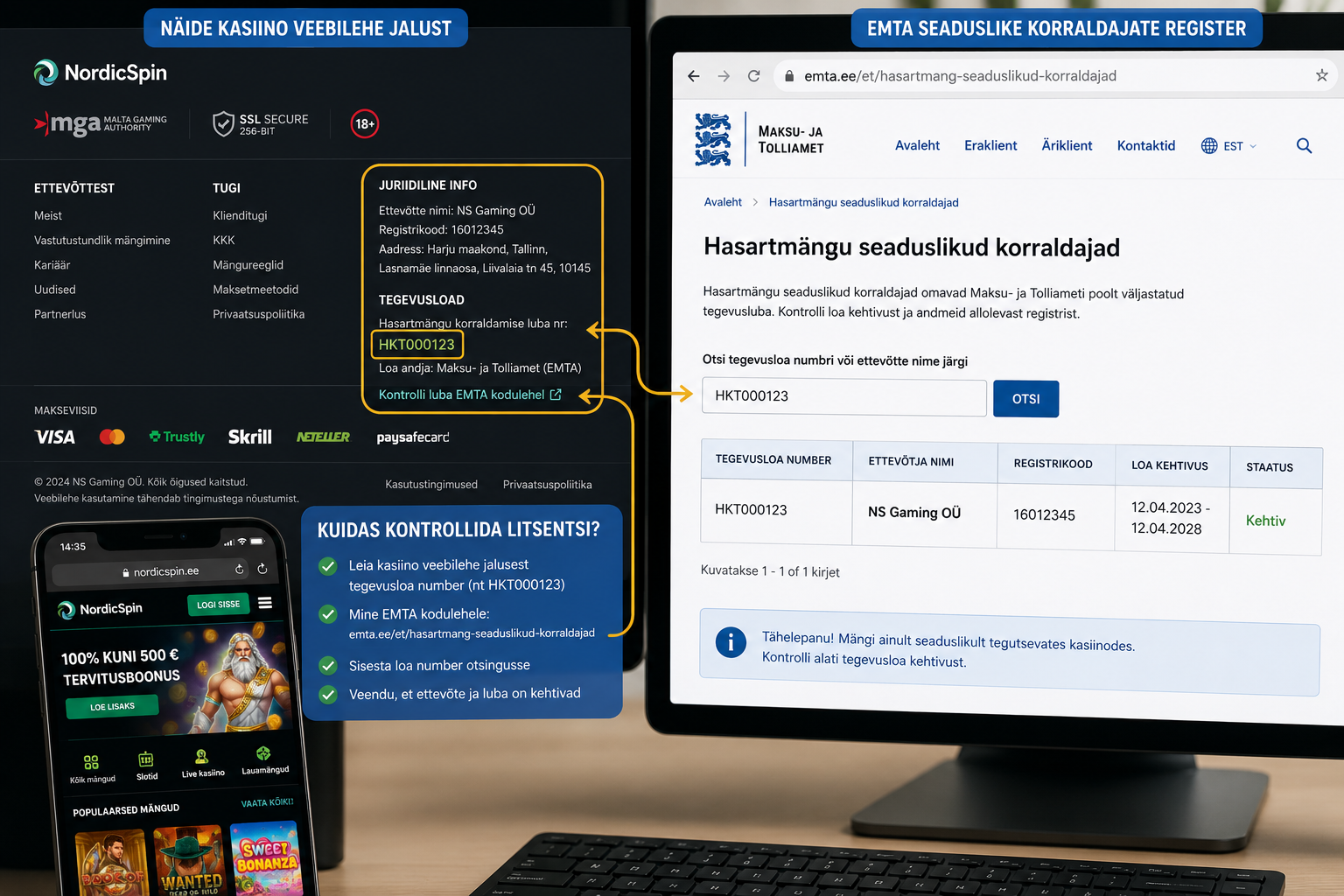
- Find the details in the site footer: step 1.
Go to the very bottom of the online-casino site (the footer). There you must find legal text containing the operating company's official name (e.g. AS Korraldaja), registration code and operating-licence numbers (e.g. HKT000042 and HKL000035).
- Open the Tax and Customs Board's official register: step 2.
Don't just read the text on the casino site — fraudsters can fake the numbers. Open the Tax and Customs Board's official website (emta.ee) in a separate tab and go to the section: For the private client > Gambling > Legal gambling operators.
- Compare the data and the web address (URL): step 3.
Find the company or brand you found in the EMTA list. Most important: check that the exact web address (URL) stated on the EMTA page matches 100% the address where you currently are. If the EMTA page states kasiino.ee but you're on kasiino-pakkumised3.com, you've landed on a fraudulent mirror site!
How to check a casino's licence
The Estonian licence (EMTA) vs. foreign licences (MGA, Curaçao, UKGC)
Many foreign gambling portals advertise themselves with global licences. But the Estonian player must know that legally and financially there's a huge difference between them.
1. Malta Gaming Authority (MGA)
MGA is one of Europe's best-known and strictest regulators. They ensure high game quality and data security.
- The Estonian player's view: although MGA casinos are technically very safe, in Estonia without a local licence they're illegal. This means the state can block their domains and bank payments. In addition, EMTA won't solve your problems with an MGA casino.
2. Curaçao eGaming
The Curaçao licence is the cheapest and most easily obtainable in the iGaming world. It's often used by casinos offering cryptocurrency betting.
- Warning: the Curaçao regulator almost never intervenes in disputes between player and casino. If a Curaçao casino decides to void your winnings, you have no real way to get your money back. In addition, winnings from a Curaçao-licensed casino are subject to 22% income tax in Estonia.
Comparison of the main gambling licences for the Estonian player
| Licence issuer (jurisdiction) | Legal status in Estonia | Taxation of winnings in Estonia | Player's legal protection | Fast payments (Pay N Play) |
|---|---|---|---|---|
| EMTA (Estonia) | 100% legal | Fully income-tax-free | Highest (state consumer protection) | Yes (Trustly, Brite, Zimpler) |
| MGA (Malta) | Illegal (block risk) | Obligation to pay income tax (22%) | Medium (MGA disputes department) | Rarely (limited for Estonian residents) |
| Curaçao | Illegal (high risk) | Obligation to pay income tax (22%) | None (regulator doesn't intervene) | No (only manual payments/crypto) |
| UKGC (UK) | Illegal (closed in Estonia) | Obligation to pay income tax (22%) | High (aimed only at UK residents) | No |
How to identify fake licences and copied websites?
Cybercriminals have become extremely skilled in 2026. They create identical copies of popular Estonian and foreign fast casinos to extract deposits.
Checking the digital signature and clickable logo
Many licence issuers (for example MGA and Curaçao) require the logo in the casino footer to be a dynamic clickable link leading straight to the regulator's official subdomain, where a unique certificate with the status "VALID" is shown.
- A sign of fraud: on fraudulent sites the licence logo is simply an ordinary static image (a .png or .jpg file), clicking on which does nothing or simply redirects back to the casino's home page.
Expert advice: domain-name anomalies
Always look critically at the browser's address bar. Fraudulent websites often use the original brand's name with arbitrary numbers or dashes added (e.g.
brandcasino-24.comorkasiino-estonia.net). An official Estonian online casino uses clean, registered domains and is always entered in EMTA's list of legal sites.
The licence's impact on financial security: withdrawals and money withdrawal
A licence regulates not only whether you may play, but also what happens to your money after the gaming session ends.
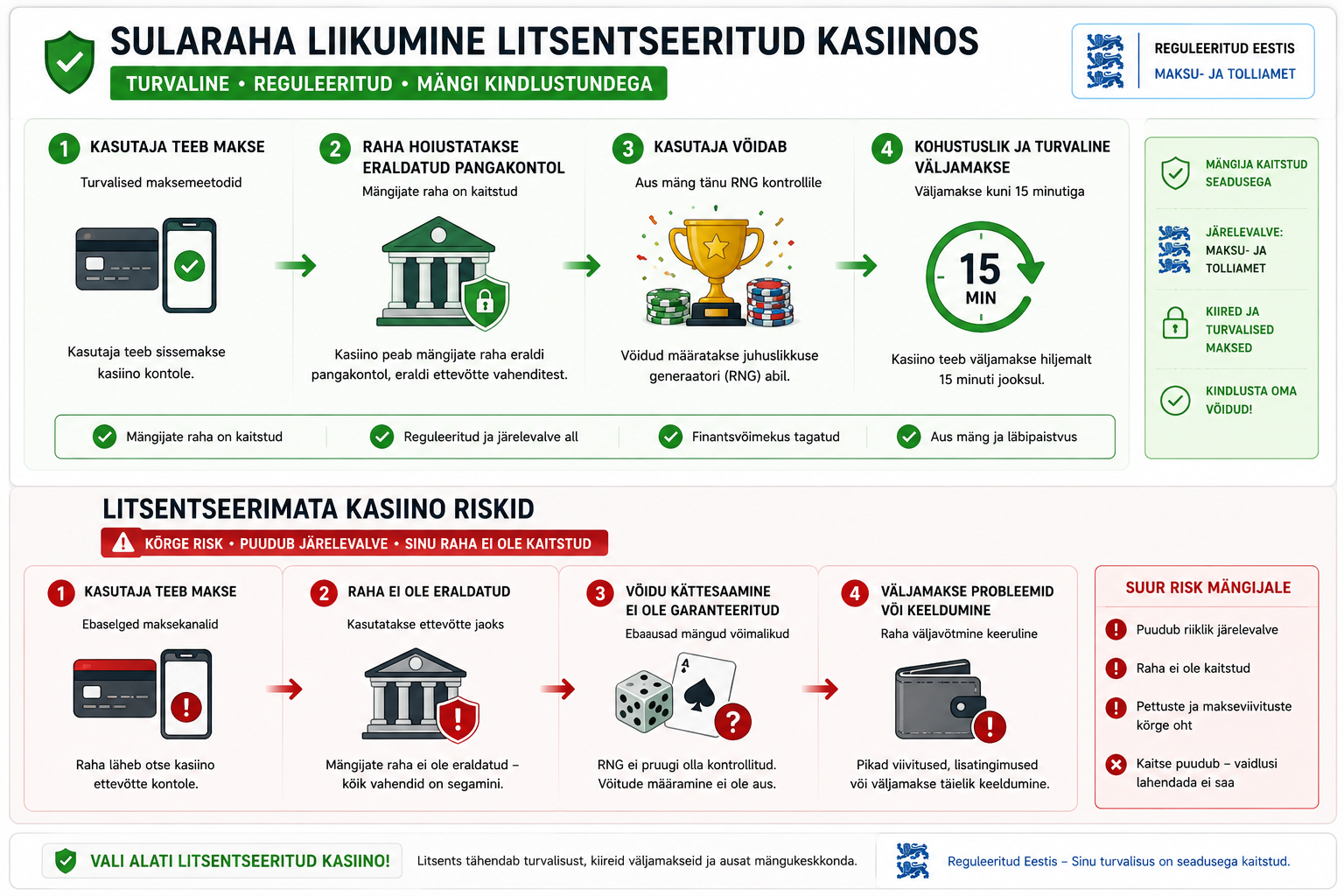
The segregation-of-funds rule
One of the strictest requirements the Tax and Customs Board places on its licensees is the complete separation of players' funds and the company's operating expenses.
- How does it protect you? The casino may not use the money you deposit to pay its staff's salaries, for marketing campaigns or website development. Your money is held untouched in a separate trust account. Even if the casino goes bankrupt, your money withdrawal is fully guaranteed by the state.
- Fast-casino advantages: the fast-casino model operating in Estonia is financially even safer, because transactions go straight through the bank-link system (Brite, Trustly, Zimpler), meaning large withdrawals reach your account immediately, without long manual processing times.
If you want to dig deeper into this model, where a bank link replaces the separate login, a detailed Pay N Play casinos comparison helps you find operators with instant Estonian withdrawals.
How does a licence ensure the fairness of games and software?
A myth is often spread among players that a casino can determine who wins and who loses at the push of a button. On a licensed market this is technically impossible.
The random number generator (RNG) and its audit
The licence terms require that all casino games must be based on a certified random number generator, i.e. an RNG. The casino itself has no access to the games' source code — the games are run from the servers of licensed software makers (e.g. NetEnt, Evolution, Pragmatic Play).
Licence issuers require that third, entirely independent international testing labs (such as eCOGRA, iTech Labs or GLI) audit the casino's software every month. These labs check millions of virtual spins to make sure the games' real return percentage (RTP) matches what's promised in the game terms.
Responsible gambling and the licensor's role in protecting the player
One of the biggest differences between a legitimate licence and a pirate site lies in how they behave when a player develops gambling-related problems.
Mandatory self-limitation tools
A safe casino is obliged to integrate player-protection functions into its system. When you log in to your account (where either a traditional registration or a fast-casino login has been done), the following settings must be immediately available to you:
- Maximum deposit limit: you can set it so you can't pay more than, for example, €50 a week into the account.
- Loss limit: automatically restricts play when your losses exceed the set amount.
- Session limit: the system automatically logs you out when you've played, for example, one hour.
Illegal and unlicensed casinos often ignore these requests or deliberately make setting limits difficult, since their goal is to extract the maximum money from the player.
Common mistakes players make when checking a licence
Even experienced players can fall into a trap if they draw superficial conclusions when checking a licence.
- Mistake 1: the belief that if a site opens, it's legal. Many think the Estonian state automatically blocks all illegal sites. EMTA constantly updates the blacklist, but new fraudulent sites appear every day. The fact that a site isn't blocked yet doesn't mean it has an EMTA licence.
- Mistake 2: "The casino is safe because it has a mobile-casino app." Google Play and the Apple App Store do checks, but apps that direct the user straight to unregulated offshore casinos constantly slip through their filters. Having an app doesn't replace an official licence check.
Pros and cons: EMTA-licensed casinos vs. offshore sites
Let's look objectively at the strengths and weaknesses of both options from the player's perspective.
An EMTA-licensed Estonian online casino
- Pros: winnings are 100% income-tax-free; fast money withdrawal to local banks in minutes; safe registration via a bank link; state legal protection in disputes; Estonian-language support.
- Cons: campaigns and the casino bonus may be more strictly regulated; no option to bet in cryptocurrency (Bitcoin, Ethereum etc.).
A casino with an offshore licence (Curaçao, Costa Rica etc.)
- Pros: often a massive welcome bonus and campaigns without restrictions; the option to play anonymously with crypto.
- Cons: you must pay 22% income tax on all winnings; a real danger of being left without money; no legal protection whatsoever in Estonia; domains can be blocked by the state overnight.
A safe-licence checklist for the Estonian player
Use this table every time you discover a new and interesting online-casino platform.
| Element to check | What must you find? | Status confirmation (yes / no) |
|---|---|---|
| Footer text | A clearly visible company name, reg. code and EMTA licence numbers. | [ ] |
| EMTA list | The company name and exact web address are stated in the emta.ee list. | [ ] |
| URL match | The URL in the browser address bar matches 100% the address stated on the EMTA page. | [ ] |
| Clickable MGA/Curaçao logo | If the casino has a foreign licence, clicking the logo leads to the official certificate. | [ ] |
| SSL encryption | There's a padlock icon before the address bar and the protocol starts with https://. | [ ] |
| HAMPI system | The account settings have a direct link to the Estonian gambling-restriction register. | [ ] |
Frequently asked questions (FAQ)
What is an online-casino licence?
An online-casino licence is an official legal operating permit issued by a state authority (in Estonia the Tax and Customs Board). It obliges the casino to follow strict rules on protecting players' data, ensuring financial security and maintaining the fairness of games.
How to check whether an online casino has an Estonian operating licence?
For this you need to go to the casino site's footer, copy the company name or operating-licence number from there and check it in the "Legal gambling operators" list on the Tax and Customs Board's (EMTA) official website.
Do I have to pay income tax if I play at an EMTA-licensed casino?
No, all withdrawals and winnings obtained at an online casino with an official Estonian licence are fully income-tax-free for the player. Gambling tax is declared and paid to the state by the casino operator itself.
Is it safe to play in Estonia at a casino with a Maltese (MGA) licence?
Technically an MGA licence is very safe and reliable. But under Estonian law an MGA casino operating without a local EMTA licence is illegal. This means the state can block the site, and you're obliged to declare the winnings there and pay 22% income tax on them.
What does a clickable licence logo on a casino's website mean?
It's a security measure where clicking the licensor's logo at the bottom of the site (e.g. MGA or Curaçao) opens the official certificate on the regulator's own page. This proves the operating licence is real, active and valid, not just a copied image file.
Do fast-casino type sites always have a licence?
Most fast casinos operating in Estonia have a valid EMTA licence, since they use payment systems working through Estonian banks. Still, with fast casinos too you should make sure it's an official and licensed brand by checking the data on the EMTA page.
How do I know if the live casino and slots are fair?
At licensed casinos the games and their random number generators (RNG) are regularly audited by independent international organisations such as eCOGRA and iTech Labs. They ensure the mathematical algorithms are fair and can't be changed by the casino.
Can a casino close my account if they have a licence?
Yes, a licensed casino has the right and a legal obligation to close or restrict an account if a rule breach, suspicion of money laundering, creation of duplicate accounts is detected, or if the player sets themselves a gambling restriction (HAMPI). The real-money balance is returned to the player if no fraud is detected.
Why does the state block unlicensed casinos' websites?
The Tax and Customs Board blocks unlicensed sites to protect Estonian consumers from fraud, ensure fair competition on the local market and prevent the loss of tax revenue to offshore regions where there's no control over responsible gambling.
What is the biggest danger of the Curaçao licence for the Estonian player?
The biggest risk of the Curaçao licence is that that region's regulator offers players no real protection. If a casino refuses to pay out your winnings, you have nowhere to complain. In addition, winnings from such casinos are subject to income tax in Estonia.
Related topics
Conclusion and the expert's final word
Checking an online casino's licence is the most important step every player must take before placing real bets. In an era where cyber fraud and copied websites are becoming ever more sophisticated, it's reckless to trust your financial funds and personal data to a platform whose background hasn't been checked. A licence is the legal barrier separating honest entertainment from potential financial ruin.
For Estonian players the situation has been made comparatively convenient. The Tax and Customs Board works hard to keep the market clean, and the presence of a local EMTA licence gives you the best possible protection that exists in the gambling world at all. From untouchable customer accounts to fully income-tax-free withdrawals, choosing an operator with a local licence is the only sensible decision.
Never fall into the trap of shady offshore sites, however large the casino bonus or free spins they offer. Always use the three-step check given in this article, make sure the domain name is correct and matches the state register, and play only on platforms that value responsible gambling principles. Knowledge and caution are your best tools — enjoy the game safely and consciously!
Key Takeaways: How to Verify an Online Casino Licence and Avoid Scams
Checking the licence is the single most important step every player should take before depositing money into any online casino. In Estonia, gambling is regulated by the Tax and Customs Board (EMTA), which issues activity permits and maintains a public list of legally operating providers. If a casino wants to serve Estonian players, it must hold a valid Estonian gambling licence or, at minimum, a transparent and verifiable licence from a recognised jurisdiction. The most reliable way to confirm legitimacy is to open the EMTA website and check whether the operator's name and domain appear in the official register. If they are missing, you should proceed with extreme caution.
The main takeaways are simple but often forgotten. First, do not trust the licence logo in the site footer alone, because fraudulent sites copy those images with ease. Click the logo and confirm that the link leads to the regulator's official registry rather than a static picture. Second, verify that the licence number genuinely belongs to that operator and not to some unrelated company. Third, read the terms, the privacy policy and the payout rules: a legal online casino transparently discloses its company name, registration code and legal address. A secure connection (HTTPS), clear KYC requirements and SSL encryption are further signs of a trustworthy licensed platform.
The most common mistakes players make are rushing because of an attractive welcome bonus and skipping the licence check entirely. Scammers rely on exactly this psychology: loud promises, unrealistic bonus percentages and pressure to register immediately. If an offer seems too good to be true, it usually is. Another typical error is ignoring the payment methods: a reliable licensed casino offers well-known, traceable payment solutions and clear withdrawal conditions, not only anonymous channels that leave you with no recourse.
What should you do next? Before registering, build a short checklist: consult the EMTA list, confirm the licence validity in the regulator's register, read other users' experiences with withdrawals, and make sure customer support is genuinely reachable. If all of these boxes are ticked, you are most likely dealing with a legal and safe online casino. Verifying a licence takes only a few minutes, yet it can save you from fraud, blocked payouts and the leaking of your personal data.
Finally, a reminder about responsible gambling: in Estonia, gambling is permitted only from the age of 21. Play only with money you can afford to lose, set time and spending limits for yourself, and never chase your losses. If you feel that gambling is slipping out of your control, use self-exclusion and reach out to a support helpline. A licensed casino is the foundation of safety, but responsibility for your own wellbeing always stays with you.
Read more: the casino licence concept and the Gambling Act and MTA supervision.