What is gambling addiction? A detailed guide, warning signs and responsible gambling in Estonia
Online gambling has undergone a huge technological revolution in recent years. Today's Estonian online casino is no longer just a website but a highly optimised entertainment cent…
Online gambling has undergone a huge technological revolution in recent years. A modern Estonian online casino is no longer just a website, but a highly optimised entertainment environment. Fast withdrawals, the registration-free fast-casino model, a convenient mobile-casino interface and a real-time live casino together create a smooth and enticing user experience. To survive the competition, various game providers and operators offer ever-larger bonuses: new customers are met by a substantial welcome bonus or deposit bonus and free spins for spinning on slots.
Although for most people casino games are innocent entertainment and a way to escape everyday life, behind this fast and accessible thrill lies a serious psychological risk. Gambling addiction, or ludomania, is a progressive mental-health disorder that can strike anyone unnoticed — regardless of education level, income or age. Because the line between recreational betting and compulsive behaviour is exceptionally thin, it's critically important to understand how this addiction develops, what its early symptoms are and how to protect yourself on a regulated market.
Quick summary
- Definition: gambling addiction (ludomania) is an official mental-health disorder in which a person cannot control their betting despite devastating consequences.
- Cause: it's a neurobiological problem in which the brain gets used to the artificial dopamine surge casino games provide, developing tolerance over time.
- Warning signs: the main symptoms are chasing losses, constantly increasing stakes, secrecy and financial difficulties.
- Bonus risk: marketing offers such as a casino bonus or free spins extend playing time and can mask the deepening of a real addiction.
- Protective tools: a legal and safe casino always offers account-wide limits. Maximum protection is provided by the HAMPI self-exclusion register managed by the Tax and Customs Board.
- Getting help: in Estonia, free and confidential psychological support is offered by the Gambling Addiction Counselling Centre (phone 15410).
What is gambling addiction?
What is gambling addiction?
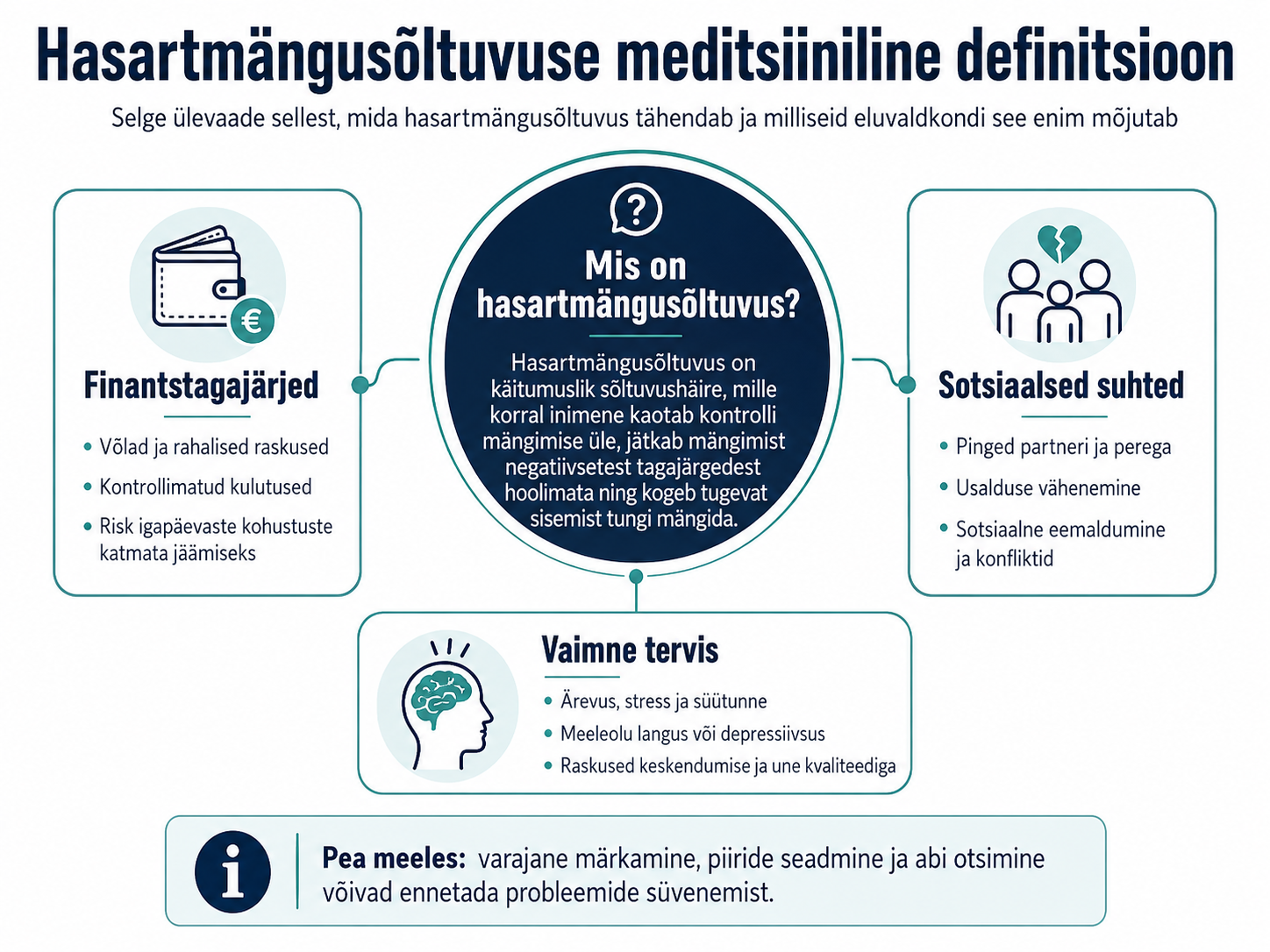
Gambling addiction, or ludomania, is a chronic, progressive and relapsing impulse-control disorder characterised by an irresistible and uncontrollable urge to gamble despite the severe social, financial, family and professional harm that results.
In international medical classifications (such as DSM-5 and ICD-10), gambling problems are no longer classified simply as a "disorder of habits and impulses", but are placed in the same category as chemical addictions (alcoholism, drug addiction). This means that although the gambler introduces no chemical substance into their body, their central nervous system reacts and transforms during betting similarly to drug addiction.
For the gambler, at some point gambling loses its original function — entertainment. It's no longer a way to spend time enjoyably or feel a mild thrill, but becomes a compulsive activity and the main means of emotional regulation. A person suffering from addiction plays to relieve stress, escape reality or re-experience a specific euphoria that everyday life can no longer offer them.
Casino bonuses and marketing traps: psychological pressure on the player
To understand the deepening of addiction in the digital age, we must look at how a modern Estonian online casino markets its products. Competition on the iGaming market is fierce, and operators use data science and psychology to keep users on their platform as long as possible.
How do bonuses create pseudo-security?
The most common way to attract new players is a welcome bonus or an initial deposit bonus. For example, a player is offered a campaign: "Deposit €100 and play with €200". This often comes with free spins on popular slots too.
Psychologically this triggers a shift in the player's brain called the "house money effect". It seems to the player that since half the money came from the casino, their personal risk is low or non-existent. This reduces the sense of danger and makes the person place much larger and riskier bets than they would with their own pure money.
The hidden psychological pressure of wagering requirements
The greatest risk point arises when the player starts meeting the bonus's wagering requirements. If the bonus amount is subject to, say, a 35x wagering requirement, it means that to actually release a €100 bonus you must place €3,500 worth of bets.
If the player has already won a nice sum and has, for example, €600 of "bonus money" on their account, a strong sense of ownership arises — they perceive this money as already theirs. When the balance starts shrinking during wagering, the player panics. Instead of stopping, they make a new deposit with their own funds to "save" the bonus. This is a classic psychological trap where a marketing tool imperceptibly pushes the player into a loss-chasing cycle.
How does gambling addiction develop? Neurobiology and dopamine
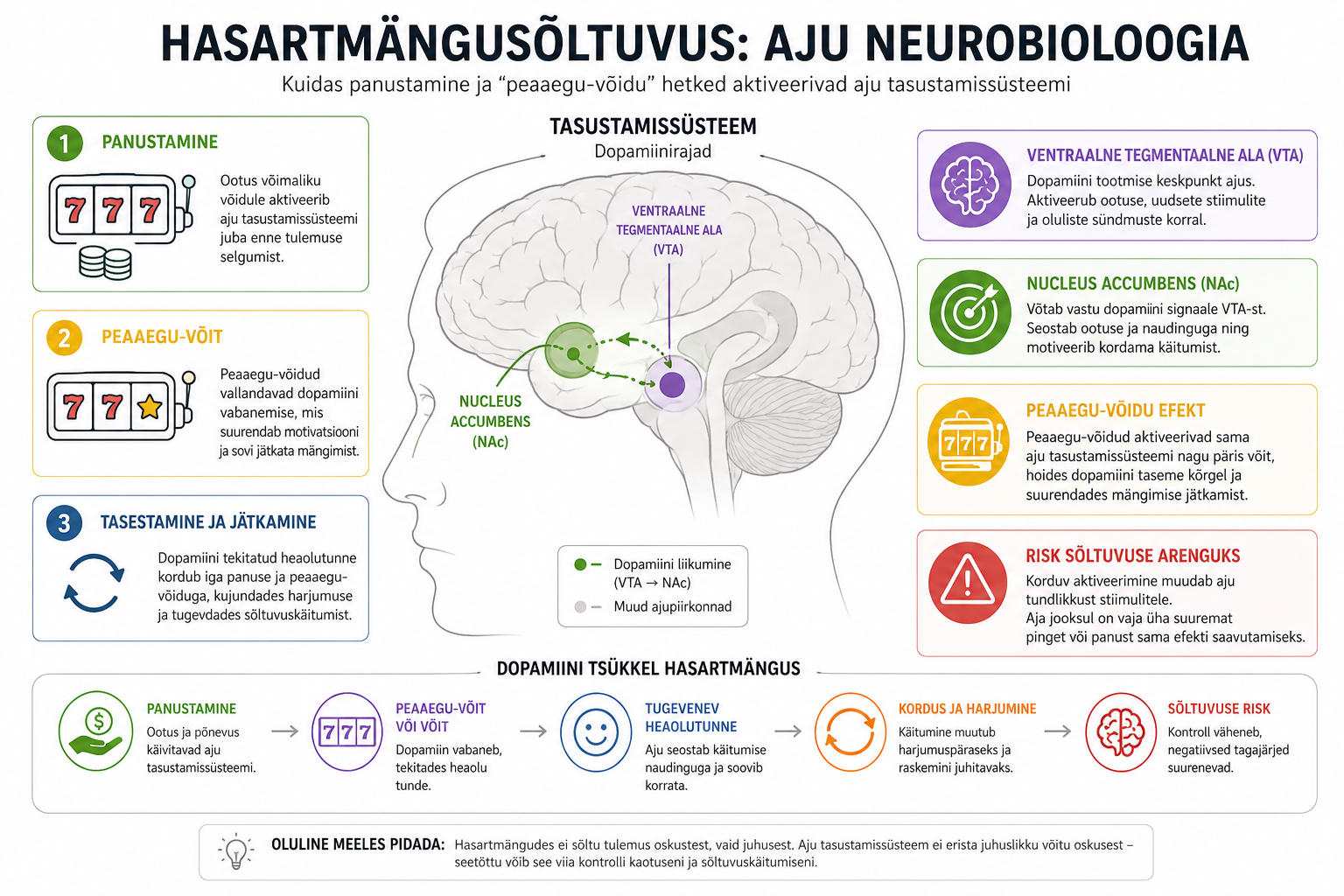
The onset of addiction is not caused by a person's bad character, lack of upbringing or low intelligence. It's a purely neurobiological process taking place in the brain's reward system, i.e. the mesolimbic tract.
The role of dopamine and the "near-miss" phenomenon
When you place a bet and the reels start spinning, the brain enters an anticipation phase. At that moment a large amount of dopamine — the neurotransmitter responsible for excitement, motivation and the feeling of reward — is released into the brain. It's important to understand that dopamine is released not only when an actual money withdrawal is achieved, but is released most of all precisely before the result becomes known, i.e. at the moment of risk and anticipation.
Casino game developers and game providers know this perfectly. That's why functions like "near misses" are programmed into the games. For example, in a slot the third symbol of the biggest winning combination stops exactly one row above or below. The brain interprets this as a "near win" and releases an almost equally large shot of dopamine as with a real win. This stimulates the player to immediately make a new spin, because the system sent the signal: "You're so close to winning!".
The development of tolerance
As with any other addiction, over time the brain adapts to the constant excess of dopamine. The sensitivity of the receptors decreases. This means that a €0.20 bet, which was originally enough, is no longer sufficient to achieve the same feeling of excitement (the dopamine hit). The player is forced to:
- Increase the size of bets (moving to, for example, €2, €5 or €20 bets per spin).
- Choose higher-volatility casino games, where wins are rarer but the risk and potential reward are many times higher.
- Extend playing sessions to hours or even days.
Phases of addiction development: from innocent play to desperation
Gambling addiction doesnt develop in a day. Its a long process that proceeds through certain psychological phases. Knowing these phases helps you notice the problem before it becomes fully destructive.
1. The Winning Phase
It usually all starts with something positive. The player takes their first steps — whether a quick registration at some new portal or using a welcome bonus. In this phase the player often experiences great beginners luck or a large one-off win.
- Effect: this creates a false sense of power. The brain stores the information: "Gambling is an easy way to earn quick money and get positive emotions." Playing becomes more frequent and bets grow.
2. The chain of losses and chasing (The Losing Phase)
Mathematical reality and the house edge sooner or later take their toll. The player starts losing. The main sign of this phase is an irresistible urge to win back lost money, which in iGaming psychology is called "chasing losses".
- Effect: the player cant accept the loss. They believe the next money withdrawal will solve the problem and make up for previous minuses. In this phase they start hiding their gambling from loved ones, the first lies appear and everyday savings are put to use.
3. The Desperation Phase
The game is completely out of control. The players thoughts are occupied by gambling 24/7: how to find money for the next bet and how to hide existing debts.
- Effect: in this phase they take out quick loans, empty family members credit cards, sell off personal property or commit financial crimes (e.g. embezzling an employers money). Relationships with family fall apart, serious problems arise at work, and the player is accompanied by a constant, gnawing sense of guilt and anxiety.
4. The Hopelessness Phase
The player realises they have lost everything — finances, trust, relationships and career. They know they cant win but keep playing, because it has become their only way to switch off their painful reality. In this phase the risk of severe depression and suicidal thoughts is exceptionally high. This stage requires immediate and professional medical intervention.
The main signs and symptoms of gambling addiction
Since ludomania leaves no physical traces on the body (unlike alcohol or drugs), it's often called a "hidden illness". The symptoms show in a person's behaviour, emotions and financial affairs.
How to notice the problem? The main warning signs:
Financial signs
- Unexplained shortage of money: a person with a stable income is constantly out of money, spending is done within a few hours on payday, bills are unpaid.
- A tangle of debts: constant borrowing from friends, acquaintances or several quick-loan companies without any logical justification.
- Disappearance of valuables: electronics, jewellery or other items start disappearing from home, taken to a pawnshop to finance the next deposit.
Behavioural and social changes
- Loss of sense of time: a promise of "I'll only play for 15 minutes" regularly stretches into a 5–6-hour night session.
- Isolation and secrecy: the player shuts themselves in their room, hides the smartphone or laptop screen from others and reacts aggressively when asked what they're doing.
- Loss of interests: former hobbies, sports, friends and family duties are neglected. All focus is directed at planning the next bet.
Emotional symptoms
- Irritability and mood swings: sudden and unexplained anger, nervousness or apathy directly linked to whether the last withdrawal was successful or the session ended at zero.
- Guilt and falling self-esteem: after every big loss the player feels deep self-contempt but can't break out of the cycle on their own.
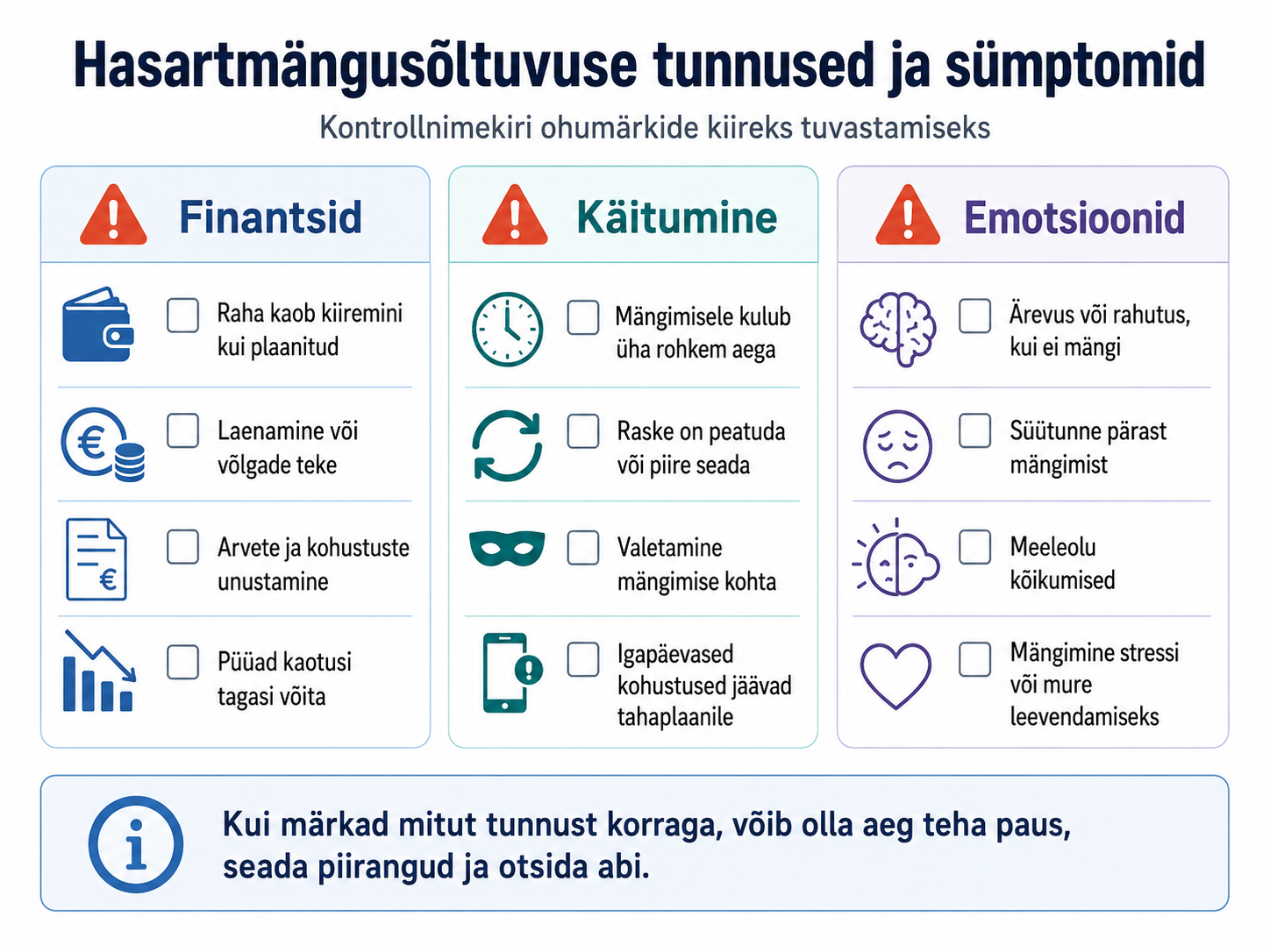
Self-assessment checklist: rate your gambling behaviour
Responsible-gambling specialists recommend that every active player take an anonymous self-assessment test at least once every couple of months. Answer the following statements completely honestly, based on your behaviour over the past year.
Checklist: test yourself
- [ ] 1. Have you ever played longer or with larger sums than you allowed yourself before starting to play?
- [ ] 2. Do you need ever-larger bets and riskier games to achieve excitement?
- [ ] 3. Have you felt irritation or restlessness when you tried to cut down on gambling or stop it entirely?
- [ ] 4. Are gambling games a way for you to escape stress, worries, boredom or loneliness?
- [ ] 5. Do you return to the casino in the following days after losing money, to win back the lost sums?
- [ ] 6. Have you ever lied to your loved ones, friends or colleagues about how much you actually play or how much money you've lost?
- [ ] 7. Have you neglected your work, studies or family duties because of gambling?
- [ ] 8. Have you had to borrow money, take quick loans or sell things to pay off gambling debts or make new deposits?
- [ ] 9. Have you tried to control or limit your gambling behaviour but failed?
Analysis of results:
- 0 yes answers: your gambling is currently under control. Keep it up and don't forget the limits.
- 1–2 yes answers: the first warning signs are there. You're at risk of falling into the grip of problem gambling. It's high time to set strict limits or take a time-out.
- 3–4 yes answers: your gambling behaviour has become problematic. It's already affecting your everyday life and finances. We recommend a longer self-exclusion and consulting support people.
- 5 or more yes answers: the results point to a serious gambling addiction. Control is completely lost. You need an immediate full gambling ban (HAMPI) and professional psychological help.
Step-by-step guide: how to set limits at a casino
Estonia's Gambling Act obliges all licensed service providers to create technical means for players to limit their behaviour. If you play in an environment with an official EMTA licence, you have access to responsible-gambling tools in your account settings.
How to set restrictions on your casino account?
- Log in and open your profile: duration: 1–2 minutes.
Log in to your Estonian online casino account or use Smart-ID / ID-card authentication if it's a fast fast-casino platform. Go to the menu in the top corner of the screen, "My account" or "Profile settings".
- Choose 'Responsible gambling': look for the special tab.
All legal and safe casino environments have a separate section called "Responsible gambling", "Limits" or "Responsible Gambling". Click on this tab.
- Set a deposit limit: the most important financial barrier.
Set the maximum amount you allow yourself to pay into the account. Choose a period of either 24 hours, 7 days or 30 days. For example, by setting a limit of €50 per week, the system automatically blocks all subsequent payment attempts once that amount is reached.
- Set a loss limit: protection against playing away your winnings.
This limit calculates the difference between the bets you've placed and the winnings received. When your net loss over the chosen period (e.g. during a day) reaches the set limit, the system won't let you start any game or place a bet, even if you have free money on the account.
- Activate a session limit: to keep time under control.
Set the maximum number of minutes you may spend at the casino in one session (e.g. 45 minutes). When the set time is up, the mobile casino or computer version shows a warning and automatically logs you out of the game.
- Confirm the changes: note the legally mandated delay.
Tightening limits (reducing amounts) takes effect in real time and immediately. But if you want to relax limits or increase amounts in the future, by law this takes effect only after 14 days from submitting the request. This buffer period is designed to prevent emotional decisions.
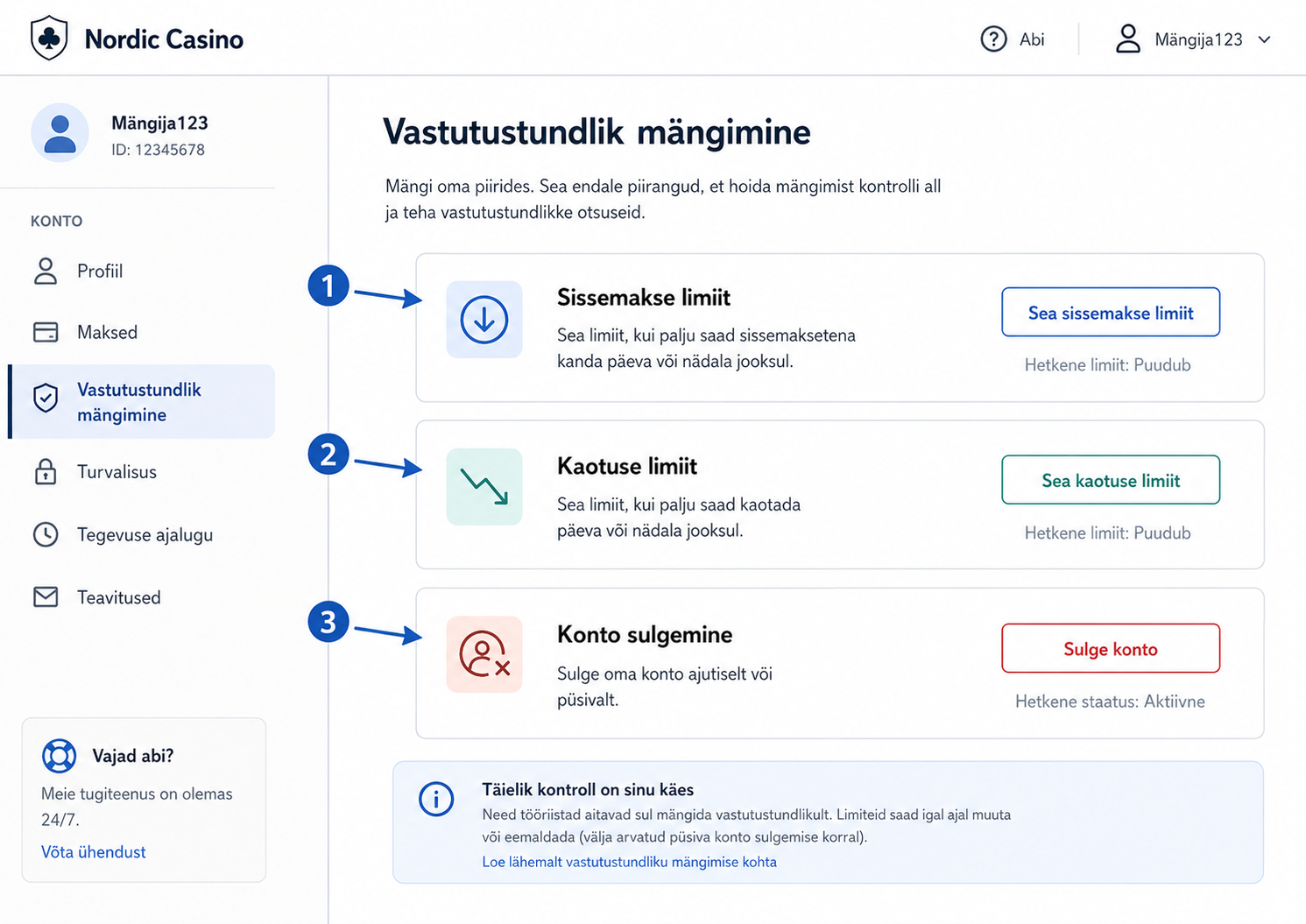
The Tax and Customs Board (EMTA) and the HAMPI register: your state protective shield
When account-wide limits are no longer enough and the player catches themselves repeatedly circumventing them (opening accounts at new casinos), the strongest self-protection tool available in Estonia must be used — the HAMPI register.
What is the HAMPI register and how does it work?
HAMPI (the list of persons with gambling restrictions) is a central electronic register created by the Estonian state, managed and controlled by the Tax and Customs Board. The purpose of this register is to give the player the ability to fully block their access to gambling across the entire territory of the country.
When a person enters themselves in the HAMPI list, the ban applies in real time and centrally. This means that if the player tries to enter any land-based casino or casino website (whether a traditional portal or a fast fast casino), the operators system makes an automatic query to the EMTA database at the moment of login. If the personal ID code is on the list, entry and betting are blocked immediately.
How to register in the HAMPI list?
An application to set a gambling restriction can be submitted in three simple ways:
- Electronically in the e-MTA environment: log in to the Tax and Customs Boards e-services (emta.ee) using an ID-card, Mobiil-ID or Smart-ID. Choose from the menu "Registrations and applications" → "Registration of a gambling restriction".
- At an EMTA service office: on site, presenting an identity document and filling in a written application.
- At a land-based casino: all legal casinos are obliged to accept a players application to set a restriction and forward it to EMTA.
Important conditions and restriction options:
- Game types: the restriction can be set separately for three categories: games of chance (casinos, slots), toto (sports betting) and classic lottery (e.g. Bingo Loto, Keno Loto). Experts advise choosing all three types at once.
- Duration: the player chooses the length of the restriction themselves, in the range of 6 to 36 months.
- Irreversibility: this restriction cannot be cancelled or shortened under any conditions before the chosen term expires. Neither the casinos customer support nor EMTA officials can remove data from the list due to a players emotional plea or a change in financial situation.
Common mistakes and myths related to gambling
Gambling addiction is fed and deepened by several cognitive biases and myths that players use to rationalise their behaviour.
Expert advice: an iGaming analysts view
"The most dangerous mistake I see among online-casino players is treating gambling as an investment or a way to solve financial problems. The maths is simple and unshakeable: every legitimate casino game has a built-in house edge, i.e. RTP (Return to Player), which is always below 100%. In the long run the player is mathematically always in the red. At a casino you can only win short-term, on pure luck. As soon as you start chasing losses hoping to earn the money back, youve stepped onto the direct path to addiction."
The 3 main myths that destroy a players wallet:
- Myth 1: "This slot machine hasnt paid out for a long time, so its about to be hot and obliged to pay."
- Reality: all licensed game providers use an RNG (random number generator). Every spin is entirely independent of previous ones. The machine has no memory — the probability of getting a jackpot is exactly the same after ten losses in a row as right after a big win.
- Myth 2: "I only play with the casinos money (using bonuses), so Im not risking anything."
- Reality: as analysed above, a casino bonus and free spins are designed to extend your playing time. Wagering requirements force you to place hundreds of bets, which trains your brain with the dopamine cycle and ultimately leads, instead of a personal money withdrawal, to new deposits anyway.
- Myth 3: "Addiction is a sign of weak character and a lack of willpower."
- Reality: ludomania is a serious biopsychosocial disorder. In the addiction phase the brains reward system is physically altered, and pure willpower doesnt work there the same way as in a healthy brain. Addiction needs systematic treatment and support, not moral condemnation.
Where to find professional help and counselling in Estonia?
You dont have to and mustnt be left alone with a gambling problem. In Estonia a professional support network has been developed over the years, where help is offered confidentially and in most cases completely free of charge.
The main help organisations and contacts:
1. The Gambling Addiction Counselling Centre (HNK)
HNK is a specialised centre offering professional psychological counselling, cognitive-behavioural therapy and support groups for both gambling addicts and their loved ones.
- Short number and helpline: 15410 (open on weekdays 10:00–18:00, the call is free).
- Website: www.15410.ee
- Services: individual counselling (in Tallinn, Tartu, Pärnu, Narva and online), family counselling, peer counselling and long-term psychotherapy.
2. The Peaasi.ee mental-health portal
The Peaasi.ee team works on mental-health promotion and prevention. Through their website you can get free e-counselling from specialists who help map the initial symptoms of addiction and refer you to further treatment.
3. Gamblers Anonymous (GA)
Self-help groups based on the 12-step programme operate in Estonia. These are anonymous meetings where people with the same problem share their experience, strength and hope to recover from addiction together.
Safety and support-network checklist in Estonia
| Support platform / protective tool | Type | Who is it for? | How to activate / get in touch? |
|---|---|---|---|
| Account limits | Preventive software restriction | Every online-casino player | Via the casino account settings (immediate effect) |
| HAMPI register | State supervision (EMTA) | Players wanting a full block | In the e-MTA environment or at customer service |
| Helpline 15410 | Telephone counselling | Addicts and loved ones | By calling 15410 on weekdays |
| HNK therapy | Professional treatment | For in-depth recovery | By registering on the website 15410.ee |
How to help and support a loved one with a gambling addiction
Gambling addiction is a disease of the whole family system. It never destroys only the gambler''s life, but causes enormous emotional and financial harm to their partner, children, parents and friends.
Warnings for loved ones: what to avoid at all costs?
Don''t pay off the addict''s debts! This is the most common and tragic mistake family members make. Paying off debts (in the hope it was the last time) works in iGaming psychology as enabling the addiction. It removes the real consequences of the player''s actions from them and relieves the financial pressure, allowing them to start betting again a few weeks later. Instead of giving money, you should finance only their treatment or counselling.
How to behave and offer real help?
- Speak on the basis of facts, not accusing: don''t attack the person emotionally ("You''ve ruined our life"), but talk about specific behaviour and your feelings ("I see you spending nights gambling and our shared bank account is empty. I''m worried and I need a sense of security").
- Take control of the finances: if you live with a person with a gambling problem, separate your bank accounts, change your online-bank passwords and two-factor authentication codes. Don''t leave cash or bank cards in an accessible place.
- Support setting a HAMPI restriction: be a support to your loved one and help them log in digitally together to the e-MTA environment to establish an official gambling ban.
- Take care of yourself: the Gambling Addiction Counselling Centre offers free psychological counselling to co-dependent loved ones too. You need tools to survive and protect yourself emotionally.
Frequently asked questions (FAQ)
What is gambling addiction and how does it differ from ordinary gambling?
Gambling addiction (ludomania) is an official psychiatric disorder in which a person loses control over the extent and frequency of their betting. Unlike an ordinary hobbyist who can stop enjoying the game after reaching a limit or a loss, an addict plays compulsively, chasing losses despite the negative consequences in life.
How do I know if my gambling at Estonian online casinos has become dangerous?
The first sure warning signs are: you play with money you mustn''t lose (e.g. rent money); you try to make new deposits right after a loss to win the money back; you lie to friends and family about the time spent gambling; and you think about gambling even when doing other things.
Do casino bonuses and free spins increase the risk of addiction?
Yes. Marketing offers such as a welcome bonus, deposit bonus and free spins are designed to reduce the player''s cognitive sense of danger. The wagering requirements that come with bonuses force the player to bet for a long time, which triggers the brain''s dopamine cycle and can accelerate the development of addiction.
What is the HAMPI register and how does it work?
HAMPI is a central electronic list managed by the Tax and Customs Board (EMTA). If you register in it, an automatic real-time entry ban applies to you at all legal Estonian online-casino sites and land-based gaming halls. No fast casino or traditional casino will let you bet after that.
Can I cancel my gambling restriction early if I need money or feel fine?
No, by law this is impossible. If you''ve chosen a restriction length of, say, 12 months, it can''t be changed or cancelled merely at the player''s wish — neither the casino''s customer support nor EMTA officials. The restriction expires fully and automatically only at the end of the chosen period.
Which limits are most effective to set at a safe casino?
The most effective are a deposit limit (limits the amount you can pay into the account over a given week or month) and a loss limit (limits net loss, preventing the rapid re-playing of won sums). Using a session time limit is also useful.
Are fast casinos more dangerous in terms of addiction than ordinary ones?
The fast-casino model is exceptionally convenient, since there''s no long account registration and withdrawals happen in minutes straight to a bank account. Because transaction speed is high, an emotional player can make impulsive deposits faster. At the same time fast casinos are equally subject to EMTA, and all legal limits and HAMPI control apply to them.
Is it possible to fully recover from gambling addiction?
Yes, it''s possible to successfully recover from ludomania and live a full life without gambling. The best results come from specialised cognitive-behavioural therapy (CBT), which teaches the player to identify their psychological triggers and change behavioural patterns. In Estonia the Gambling Addiction Counselling Centre offers it free of charge.
What to do if my loved one has run up big debts because of gambling?
The most important thing is not to pay off their debts. Paying off debts lets the addict come out of the crisis cleanly and soon steers them back to gambling. Instead, talk to them calmly, steer them toward setting a state gambling restriction and register them for counselling at the Gambling Addiction Counselling Centre.
Is playing at unlicensed (foreign) casinos more dangerous?
Extremely dangerous. Casinos without an EMTA licence are not subject to Estonian laws and ignore the HAMPI register. There is no legal protection for the player there, money withdrawal can be interrupted at any moment, and responsible-gambling tools are often incomplete or non-existent. Always play only at licensed and safe Estonian casinos.
Related topics
Conclusion and the expert''s final word
The modern iGaming world, thanks to fast technologies, the convenience of the mobile casino and interactive live-casino solutions, offers exceptionally intense and accessible entertainment. A welcome bonus handed out as a campaign or enticing free spins make entry easy and exciting. But as with any source of powerful stimulation, gambling too carries a real risk to mental health and financial stability if strict, conscious self-control is lacking.
Gambling addiction is not a character flaw or a choice — it''s a neurobiological reality in which the brain''s reward system, due to constant dopamine production, falls into a cycle that''s exceptionally hard to exit on one''s own. The loss-chasing at the core of addiction is mathematically doomed to fail, because the casino''s mathematical edge always remains.
Estonia''s regulated gambling market offers players world-class self-protection systems. The supervision carried out by the Tax and Customs Board, mandatory account-wide limits and the central HAMPI register create a strong legal and technical protective shield. Use these tools preventively, not only when a crisis is already at hand. Keep gambling strictly at the level of entertainment, set yourself firm budgets and don''t be afraid to turn to specialists for help if needed (the Gambling Addiction Counselling Centre''s short number 15410). Play smart, safe and responsibly.
Key takeaways: recognising gambling addiction and gambling responsibly
Gambling addiction rarely appears overnight; it usually develops gradually and almost imperceptibly, which makes the central takeaway a simple one: monitor your own behaviour honestly and regularly. When gambling stops being entertainment and becomes a way to relieve stress, recover losses or escape everyday problems, that is a clear warning sign. A modern Estonian online casino is a technically optimised environment designed to keep a player engaged for as long as possible, and precisely for that reason the responsibility for your own pace and limits must stay in your own hands. The main red flags are loss of control over stake sizes, lying to loved ones about how much you play, disrupted sleep and concentration, and mounting financial pressure that you try to solve with yet more wagers.
The most common mistake the guide highlights is loss chasing — the belief that the next spin or bet will surely win the money back. Neither psychologically nor mathematically does this work, because every game outcome is random and independent of the one before it. A second frequent error is the absence of time boundaries: without a conscious limit, an evening of relaxation easily stretches into a multi-hour session. A third mistake is confusing entertainment with investment. Gambling is not a way to earn money or a financial solution; it is a paid pastime whose expected long-term result for the player is negative.
So what should you do next? Start with a clear budget whose loss will not affect your everyday finances, and set both money and time limits before you begin. Use the responsible gambling tools built into licensed platforms: deposit and loss limits, session length restrictions and self-assessment tests. If you feel control slipping away, in Estonia you can add yourself to the register of persons with gambling restrictions (self-exclusion), which blocks access to legal gaming environments. Talk to someone close to you and, if needed, reach out to a professional counsellor — asking for help is a sign of strength, not weakness.
In the Estonian context it is important to remember that only operators licensed by the Tax and Customs Board (EMTA) may legally offer gambling, and participation is permitted only from the age of 21. A licensed environment means controlled payouts, data protection and mandatory responsible gambling measures. Ultimately, responsible gambling comes down to awareness: play only with money you can afford to lose, keep a clear head and firm limits, and seek help the moment gambling starts to take over your life. If in doubt, take a break — entertainment that brings anxiety or financial harm is no longer entertainment.