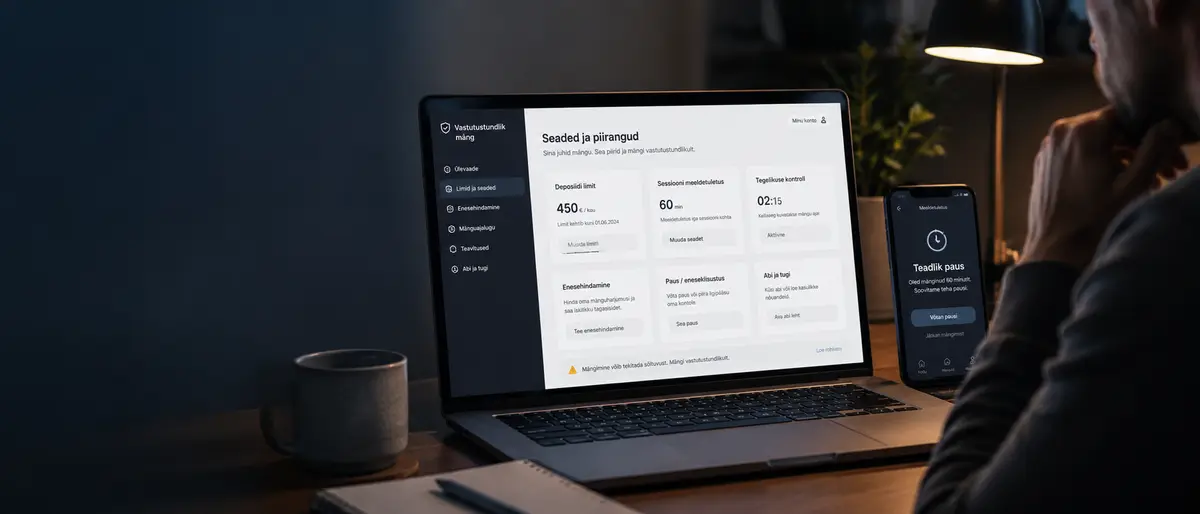
How to recognise the signs of gambling addiction and play responsibly?
The online-gambling landscape in Estonia develops at dizzying speed. Almost every Estonian online casino and innovative fast casino competes for players' attention with enticing marketing campaigns:…
The online-gambling landscape develops in Estonia at a dizzying speed. Almost every Estonian online casino and innovative fast casino tries to win players' attention by offering enticing marketing campaigns: large sums like a welcome bonus or a deposit bonus, hundreds of free spins and convenient fast withdrawals. Although these entertaining rewards are designed to enrich the gaming experience and extend playing time, behind the digital slot reels, the convenience of a mobile casino and the exciting live-casino tables lurks a real psychological risk.
Gambling is based on the release of dopamine and entertainment, but without strict self-control an innocent pastime can imperceptibly grow into a serious problem. Gambling addiction, or ludomania, is a creeping and complex behavioural disorder that affects not only the player's wallet but also destroys relationships, careers and mental health. Since a modern safe casino must today operate under strict state supervision carried out by the Tax and Customs Board (EMTA), unique and effective self-protection mechanisms have been created on the Estonian market.
This thorough expert guide was created by iGaming-field analysts and responsible-gambling specialists. Our goal is to give Estonian players — from those for whom registration is a new step to experienced hobbyists — vital knowledge and practical tools for noticing the early symptoms of addiction. In this article we break down in detail the psychological phases of addiction, map the danger signs, give a step-by-step plan for setting self-limits and explain how to use bonus offers in a way that doesn't put your wellbeing at risk.
Quick summary
- Define gambling as entertainment: gambling, including all casino games, is meant for entertainment, never for investing or solving financial problems.
- Recognise early symptoms: the main danger signs are chasing losses, hiding gambling from loved ones and constantly increasing bets to get a dopamine hit.
- Use casino limits: before making your first bet, always set deposit, loss and time limits directly in your casino account's settings.
- Activate the HAMPI restriction: if you feel control is slipping, register yourself in the self-exclusion list (HAMPI) managed by the Tax and Customs Board, which blocks your access to all licensed gambling sites in Estonia.
- Conscious bonus consumption: never make additional deposits just to fulfil some complex casino bonus or release free spins.
What is gambling addiction and how does it develop?
What is gambling addiction?
Gambling addiction (ludomania) is a chronic and progressive impulse-control disorder and psychological addiction in which a person is unable, despite negative social, financial or emotional consequences, to control their urge to gamble.
The emergence of gambling addiction is closely tied to the human brain's reward system. When you play in an online casino environment and a winning combination appears on the reels, the brain releases a large amount of dopamine — a neurochemical that produces euphoria and satisfaction. Over time the brain adapts to this artificial stimulation, developing tolerance. This means that to reach the same level of excitement the player needs ever-larger bets and longer gaming sessions.
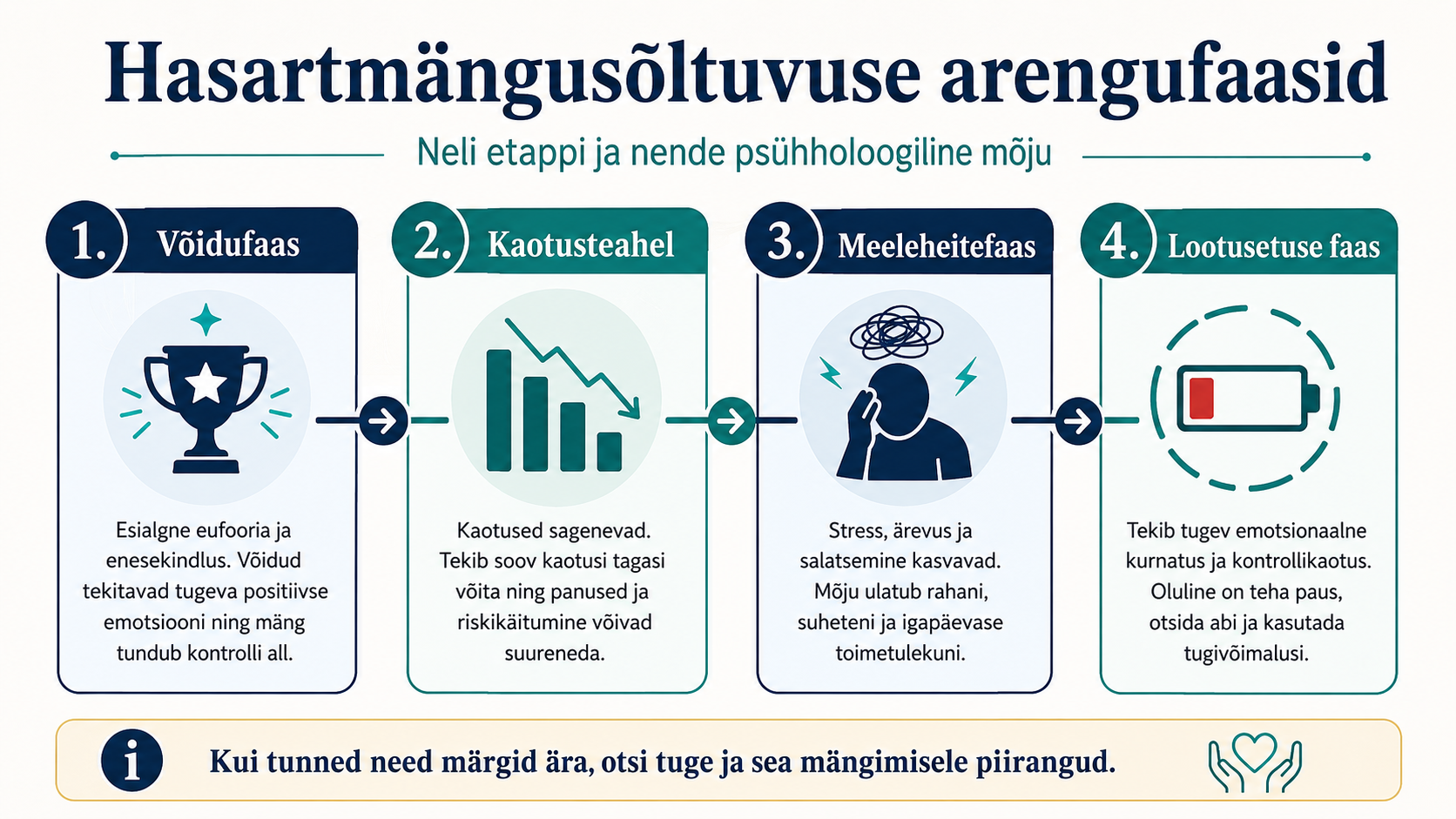
Psychologists usually divide the development of gambling addiction into four main phases:
1. The winning phase
The player initially experiences a big win or several consecutive successes. This creates a feeling of power and excitement, as well as a mistaken belief that the player can outsmart the algorithms or has a special "lucky hand". In this phase gambling starts being repeated more and more often.
2. The losing chain and chasing (Losing Phase)
Luck turns, which is mathematically inevitable (due to the house edge). The player starts losing, but instead of stopping, an irresistible urge arises to win back the lost money. This is a critical turning point that iGaming analysts call "chasing losses". Gambling turns from a hobby into an obligation and starts being hidden from loved ones.
3. The desperation phase
Control is completely lost. The player spends funds meant for living, takes out loans, empties credit cards or sells personal belongings to finance their bets. In this phase work and family life suffer seriously, accompanied by sleep disorders, depression and constant anxiety.
4. The hopelessness phase
The player understands they are in a hole they can't climb out of on their own, but keeps playing because it works as the only temporary means of escaping reality. This phase requires quick and professional medical and psychological intervention.
The main signs and symptoms of gambling addiction
Addiction is often called a "hidden illness", because unlike alcohol or drug addiction it has no direct physical symptoms. Nevertheless there are specific behavioural patterns that fall into financial, emotional and social signs.
Financial danger signs
- Exceeding the budget: the regular situation where the player allows themselves to spend only €20 but notices a couple of hours later that several new deposits have been made from the account.
- Borrowing money to gamble: taking out quick loans, asking friends or family for money "for emergencies", which in reality goes straight to the fast-casino account.
- Secret accounts: using several different bank accounts or hidden e-wallets to conceal gambling-related transactions.
Behavioural and emotional changes
- A state of preoccupation: the player is physically present (e.g. at a family dinner or at work), but their thoughts are constantly on the next bet, a new slot game or an unfinished casino bonus.
- Irritability and mood swings: sudden anger or depression directly linked to the result of the last gaming session.
- Loss of the sense of time: the inability to stop playing at the agreed time. They play into the night hours, sacrificing hours of sleep and everyday duties.
A table for assessing the severity of danger signs
| Symptom / Behaviour | Risk level | Description / Action plan |
|---|---|---|
| You play longer than you planned | Low / Warning | Time to review the time-limit settings on the casino account. |
| You increase bets to feel excitement | Medium | A classic tolerance symptom. A gambling break is needed. |
| You try to immediately win back lost money | High | A dangerous behavioural pattern (chasing). Requires immediate blocking of deposits. |
| You lie to loved ones about the sums spent | Critical | Addiction is controlling behaviour. It's recommended to contact counsellors and activate HAMPI. |
| You take out a loan or sell things to bet | Critical | Financial collapse. Immediate full self-exclusion and professional help. |
The psychological impact of casino bonuses: how does marketing affect us?
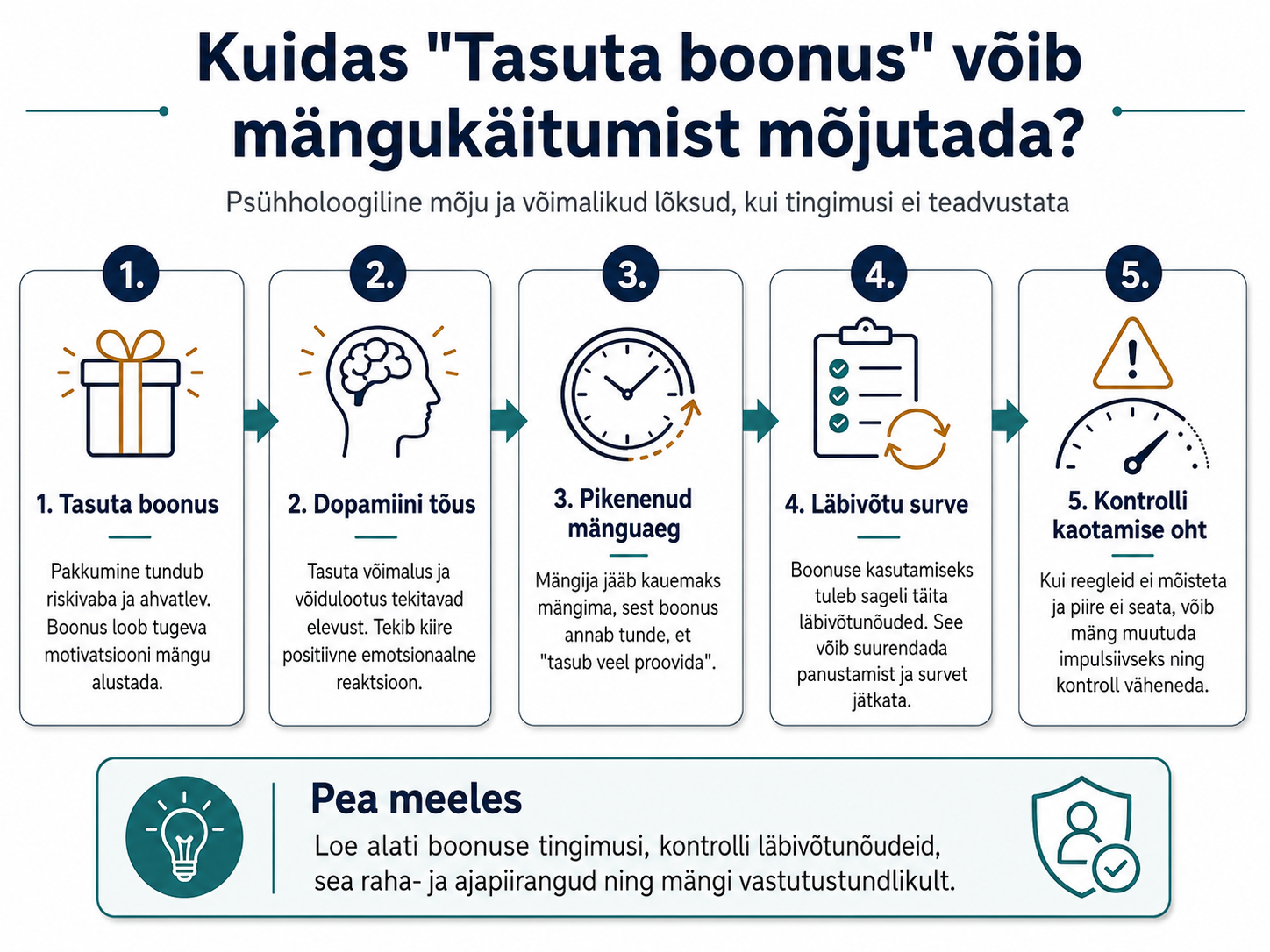
The gambling industry is a highly developed iGaming ecosystem where marketing campaigns are designed on the basis of psychological principles. Offers like casino games to try for free, a welcome bonus or a risk-free bet trigger in the human brain a cognitive shift called the "pseudo-safety effect". The player is left with the impression that they're playing with "the casino's money" and the risks are minimised.
The wagering requirement as a psychological trap
The biggest hidden emotional danger lies in the condition called the wagering requirement. When a 100% deposit bonus is activated, the player's funds are locked until the requirement is met.
If the player's balance holds, for example, €500 of bonus winnings but the wagering is only 40% complete, a strong sense of ownership arises in the brain — the player already perceives this money as their own. When the balance starts to shrink, panic kicks in and the urge to make new deposits to "save" the unfinished bonus intensifies. In this way an innocent casino bonus can turn into a catalyst that pushes the player into a cycle of chasing losses.
Self-testing questionnaire: is your gambling under control?
To promote responsible gambling, psychologists have developed simple but deep self-testing questionnaires (based on the DSM-5 diagnostic criteria). Answer the following questions completely honestly with yourself.
Checklist: a self-assessment test
- [ ] 1. Have you caught yourself thinking that you need ever-larger sums to gamble in order to achieve the desired excitement?
- [ ] 2. Do you become restless or irritable when you try to cut down gambling or stop it entirely?
- [ ] 3. Have you repeatedly and unsuccessfully tried to control, limit or stop gambling?
- [ ] 4. Is gambling for you a way to escape everyday problems, stress, depression or anxiety?
- [ ] 5. After losing money, do you return to the casino almost immediately or the next day to win back the lost amount?
- [ ] 6. Have you lied to family members, friends or a therapist to hide the extent of your gambling or the sums spent?
- [ ] 7. Have you endangered or lost, because of gambling, an important relationship, a job, a study opportunity or a career?
- [ ] 8. Do you rely on other people's (family, friends) financial help to rescue yourself from a desperate financial situation caused by gambling?
Interpreting the results:
- 1–2 affirmative answers: there are signs of beginning risk behaviour in your gambling. It's high time to set strict limits.
- 3–4 affirmative answers: this is problem gambling. It's recommended to take a longer gambling break and consult specialists.
- 5 or more affirmative answers: points to established gambling addiction. Immediate blocking of access to gambling sites and seeking professional help is necessary.
Step-by-step guide: how to set limits and protect yourself
Every legal and safe casino with an EMTA licence offers special responsible-gambling tools on its platform. These tools are built directly into your account settings and work as software barriers.
A step-by-step action plan for setting limits
- Log into your account: enter your favourite Estonian online casino portal or log in with an ID-card/Smart-ID into a registration-free fast-casino environment.
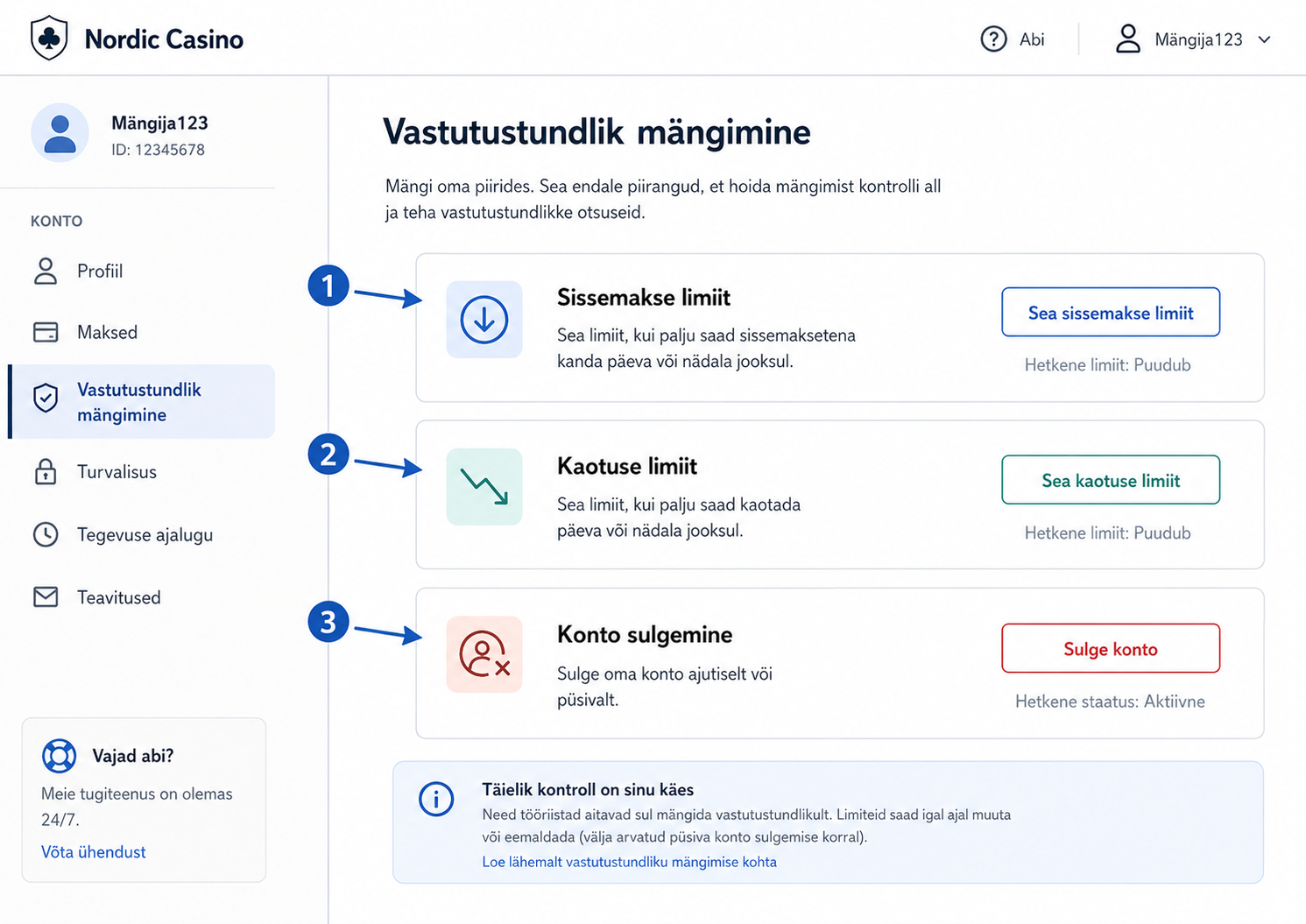
- Open account settings: click your profile icon and look for a section called "Responsible Gambling", "My limits" or "Responsible Gaming".
- Set a deposit limit: choose a period (day, week or month) and enter the maximum sum you allow yourself to transfer to the account. When the limit is reached, the system automatically blocks new payment attempts.
- Set a loss limit: this limit counts not deposits but your net loss (bets minus winnings). If you lose the set limit (e.g. €50 a week), the software no longer lets you place bets.
- Activate a session limit: define how many minutes or hours you can stay in the casino at once (e.g. 60 minutes a day). When the time is up, you're automatically logged out.
- Use the "Cooling-off" button: if you feel emotional tension after a big loss, choose an immediate account freeze for 24 hours, a week or a month. This decision can't be cancelled by the casino's customer support at the player's request before the set time has passed.
The EMTA licence and the HAMPI list: Estonia's state protection mechanisms
The Estonian gambling market is one of the best-regulated in the world, thanks to which players have a unique legal and technical protective shield. Supervision is strictly carried out by the Tax and Customs Board of the Republic of Estonia.
What is HAMPI?
HAMPI (the list of persons with a gambling restriction) is a state electronic register into which Estonian citizens and residents can voluntarily enter their data in order to block themselves full access to all licensed land-based and online casinos and betting shops in Estonia.
When your data is entered into the HAMPI list, the restriction is applied centrally. If you try to enter some Estonian online casino environment or perform a fast login at some fast-casino portal, the system automatically checks the state register via X-tee. If you're on the list, an entry ban is immediately displayed to you, and opening an account or placing bets is technically impossible.
How to add yourself to the HAMPI list?
- Via e-Tax: log into the EMTA web environment (emta.ee) using an ID-card, Mobiil-ID or Smart-ID. Look in the menu for the section "Registration of a gambling restriction" and fill in the electronic application.
- At the casino on site: the application can also be submitted physically at the cashier of any legal land-based casino or at an EMTA service office.
- Restriction period: when submitting the application, the player can choose a restriction duration of 6 to 36 months. This restriction cannot under any conditions be cancelled before the end of the chosen period — this rule is created to protect the player from emotional breakdown moments.
Common mistakes and myths that deepen addiction
A lot of misleading information and myths circulate around gambling, which a brain with addictive behaviour uses for self-justification.
- Myth 1: "If I play long enough, a win must come mathematically."
- The real iGaming maths: every spin in a slot is a completely independent event governed by a random number generator (RNG). The machine has no memory. The probability of winning is exactly the same regardless of whether you've made 10 or 10,000 spins. The house edge always stays the same.
- Myth 2: "Bonuses and free spins are a way to outsmart the casino."
- The real iGaming maths: bonuses are entertaining marketing tools. Most of them have a negative mathematical expected value (EV), which means that in the long run the casino still wins from them. You can't earn a stable income from bonuses.
- Myth 3: "Addiction is purely a weakness of character."
- The medical reality: gambling addiction is a recognised psychiatric diagnosis (ICD-10 code F63.0). It's a neurobiological disorder, not a lack of willpower. An addict needs understanding and professional support, not condemnation.
Where to find professional help and support in Estonia?
If the self-testing questionnaire pointed to a problem or if you feel you can't stop gambling despite the limits, don't stay alone with your trouble. In Estonia special support structures have been created that offer confidential and professional help completely free.
```
[Notice the danger signs] ➔ [Immediately set an EMTA restriction (HAMPI)] ➔ [Contact the helpline 15410] ➔ [Start free counselling]
```
Important contacts in Estonia
1. The Gambling Addiction Counselling Centre (HNK)
HNK is the leading organisation in Estonia offering specialised psychological counselling and cognitive-behavioural therapy to gambling addicts and their loved ones.
- Website: 15410.ee
- Helpline: 15410 (works on weekdays, the call is free or at the normal tariff)
- E-mail: info@15410.ee
- Locations: counselling offices are located in Tallinn, Tartu, Pärnu and Narva, and in addition quality web counselling (Skype/MS Teams) is offered.
2. Peaasi.ee
A mental-health portal offering support and information for various addiction disorders and the accompanying depression and anxiety. An anonymous e-counselling service is available on the website.
3. Clinical psychiatrists and regional hospitals
In serious cases where gambling is accompanied by deep depressive states or suicidal thoughts, you can turn directly to the mental-health emergency-medicine departments of large hospitals (e.g. PERH in Tallinn or the TÜK mental-health clinic in Tartu).
How to support a loved one who has a gambling problem?
Addiction never harms only the individual — it's a disease of the family system. If you notice that your life partner, family member or friend spends hours in front of their mobile casino screen, becomes secretive and their financial situation is inexplicably critical, they need help.
Expert advice: how to behave as a loved one?
"The biggest mistake loved ones make is paying off the addict's debts or giving them new money in the hope that 'this is the last time'. In iGaming psychology this is called enabling addiction. Giving money prolongs the agony and lets the addict continue gambling. Instead, offer emotional support, help them set up the HAMPI restriction and direct them to the Gambling Addiction Counselling Centre."
A practical checklist for loved ones:
- [ ] Talk openly and without blame: choose a moment when you're both in a calm mood. Use "I" statements (e.g. "I'm worried about our finances and your wellbeing"), avoiding an attacking tone ("You've wasted everything").
- [ ] Take control of shared finances: change the bank-account passwords, introduce two-factor authentication and don't trust large sums of money to a person who is in a crisis phase.
- [ ] Take care of your own mental health: the Gambling Addiction Counselling Centre (15410.ee) offers free psychological support to addicts' loved ones too. You also need tools to get through this crisis.
Frequently asked questions (FAQ)
What is gambling addiction and how does it arise?
Gambling addiction is a chronic impulse-control disorder in which a person loses the ability to control their gambling frequency and bets. It arises as a result of changes in the brain's reward system, where the dopamine hit obtained from gambling creates psychological tolerance and an irresistible urge to repeat the action.
How to recognise that I've developed a gambling problem?
The main danger signs are chasing losses (trying to immediately win back lost money with new bets), regularly exceeding the initially set money and time frames, hiding gambling from loved ones and taking out loans to finance gambling.
What is HAMPI and how does it protect me?
HAMPI is a state register managed by the Tax and Customs Board (EMTA). If you add yourself there, a centralised entry ban is applied to all legal Estonian online and land-based casinos. The system checks your personal ID code in real time and automatically blocks account opening or gambling.
For how long can you set yourself a gambling restriction in Estonia?
When registering in the HAMPI list, the player can choose the restriction's validity period themselves, which by law must be minimally 6 months and maximally 36 months.
Can I cancel my HAMPI restriction earlier if I feel I've recovered?
No. The Estonian Gambling Act is uncompromising here: once submitted and accepted, a restriction can't under any conditions be cancelled, shortened or deleted before the chosen deadline has fully passed. This protects the player from emotional decisions.
Do fast casinos offer the same self-protection tools as ordinary casinos?
Yes, completely. Since every legal fast-casino platform is obliged to have an EMTA licence, exactly the same strict responsible-gambling rules apply to them. They're obliged to offer limit-setting systems on their page and respect the HAMPI register's bans in real time.
Can gambling addiction be treated?
Yes, it's possible to recover from gambling addiction. The most effective method is considered to be cognitive-behavioural therapy (CBT), which helps identify the thought patterns that trigger gambling and replace them with healthy behaviours. In Estonia it's offered free by the Gambling Addiction Counselling Centre.
Should I pay off my friend's or family member's gambling debts?
Experts strongly advise against directly paying off debts. This creates in the addict a sense of security that their actions have no real financial consequences, and lets them soon start betting again. Instead of money, one should offer help in organising a system of treatment and restrictions.
What is a loss limit and how does it work?
A loss limit is a casino-account setting that limits your net money losses over a certain period (day, week, month). Unlike a deposit limit, it counts the real difference between bets and winnings. If your losses exceed the set amount, the system blocks your right to place bets until the end of the period.
Do Estonian state restrictions apply in unlicensed (foreign) casinos?
They don't apply. Foreign casinos (e.g. Curacao-licensed sites) that lack an EMTA licence have no access to the Estonian HAMPI register and ignore Estonian laws. This is precisely why they're exceptionally dangerous, because the player there isn't protected by the state. Always choose only a legal, safe casino.
Where can a gambling addict's loved one get help?
Loved ones receive completely free and anonymous help at the Gambling Addiction Counselling Centre (website 15410.ee, phone 15410). Special support groups and individual counselling are offered there to help loved ones restore their mental balance and learn to behave correctly in a crisis.
Can casino bonuses worsen gambling addiction?
Yes, they can. The wagering requirements that come with bonuses can create a psychological obligation to keep gambling even when one actually wants to stop. Chasing bonuses and campaign pressure often serve as a trigger that leads into the loss-chasing phase.
Related topics
Conclusion and the expert's final word
Virtual gambling and modern digital platforms offer top-tier entertainment, but this experience stays positive only as long as the game is under full and conscious control. Gambling addiction doesn't arise overnight — it's a subtle, creeping process that begins in an innocent dopamine hunger in the winning phase and can, because of false thought patterns and the chasing of losses, lead to a serious life crisis. The skill of noticing addiction's signs early is the best gift you can give yourself and your loved ones.
iGaming-field experts and medical workers emphasise one basic truth: prevention is always many times easier and more painless than dealing with the consequences. Never sit down to play on the assumption that a casino bonus, free spins or some mysterious betting strategy will secure you a long-term income. Casino games are designed for entertainment, and a mathematical house edge is always tied to them.
Actively use the software tools — set deposit limits right after the registration process and take regular gambling breaks. And if you feel control is slipping from your hands, boldly and without delay use the excellent protection mechanisms offered by the Estonian state, such as the HAMPI register managed by the Tax and Customs Board, and contact the Gambling Addiction Counselling Centre's helpline 15410. Gambling should remain a game — keep control, play responsibly and value your wellbeing above all.
Key Takeaways: Recognising Gambling Addiction Signs and Playing Responsibly
Gambling addiction rarely appears overnight; it creeps up quietly, gradually turning what seems like harmless entertainment into a compulsion that becomes ever harder to control. The single most important message to carry away from this guide is that responsible gambling begins with awareness and honesty with yourself. When stakes climb in the hope of recovering losses, when play starts to interfere with sleep, work or relationships, or when you begin hiding your activity from family and friends, these are clear warning signs. The sooner you acknowledge them, the easier it is to change course before the financial and emotional damage accumulates.
The most common mistake players make is believing they can always win back what they have lost. This chasing of losses usually leads deeper into trouble, because online casino and fast-casino games are built on randomness, where past outcomes have no bearing on future ones. Another frequent misconception is treating bonuses as free money. A welcome bonus or a batch of free spins is a marketing tool that comes with wagering requirements, not a guaranteed profit. A responsible player reads the terms, understands the risks, and remembers that over the long run the mathematical edge always favours the house.
In practical terms, responsible gambling means setting clear limits before you even start a session. Decide on a fixed budget you can afford to lose without jeopardising your daily life, and stick to it even when the urge to try again is strong. Make use of the responsible-gambling tools that licensed operators provide: deposit and loss limits, time restrictions, reality checks, and, when needed, self-exclusion. In Estonia, those who wish can enter the national self-exclusion register (HAMPI), which blocks access to licensed gambling environments for an agreed period, giving you space to regain control.
Within the Estonian context it is essential to remember that gambling is legal only from the age of 21 and only with operators licensed by the Tax and Customs Board (EMTA). A licence means the operator must follow player-protection rules, keep player funds separate, and offer tools to curb excessive play. Unlicensed foreign sites provide none of these safeguards, and using them puts a player's rights and money at risk.
If you feel that gambling has become a problem, there is no reason to feel ashamed or to face it alone. Seeking help is a sign of strength, not weakness, and Estonia offers free, confidential counselling for people affected by addiction and for their loved ones. Gambling should remain a form of entertainment, never a way to make money or an escape from worries. Always play in moderation, set your limits, wager only money you can afford to lose, and reach out for help the moment you sense a loss of control. A responsible attitude is the best way to keep gambling safe and enjoyable.