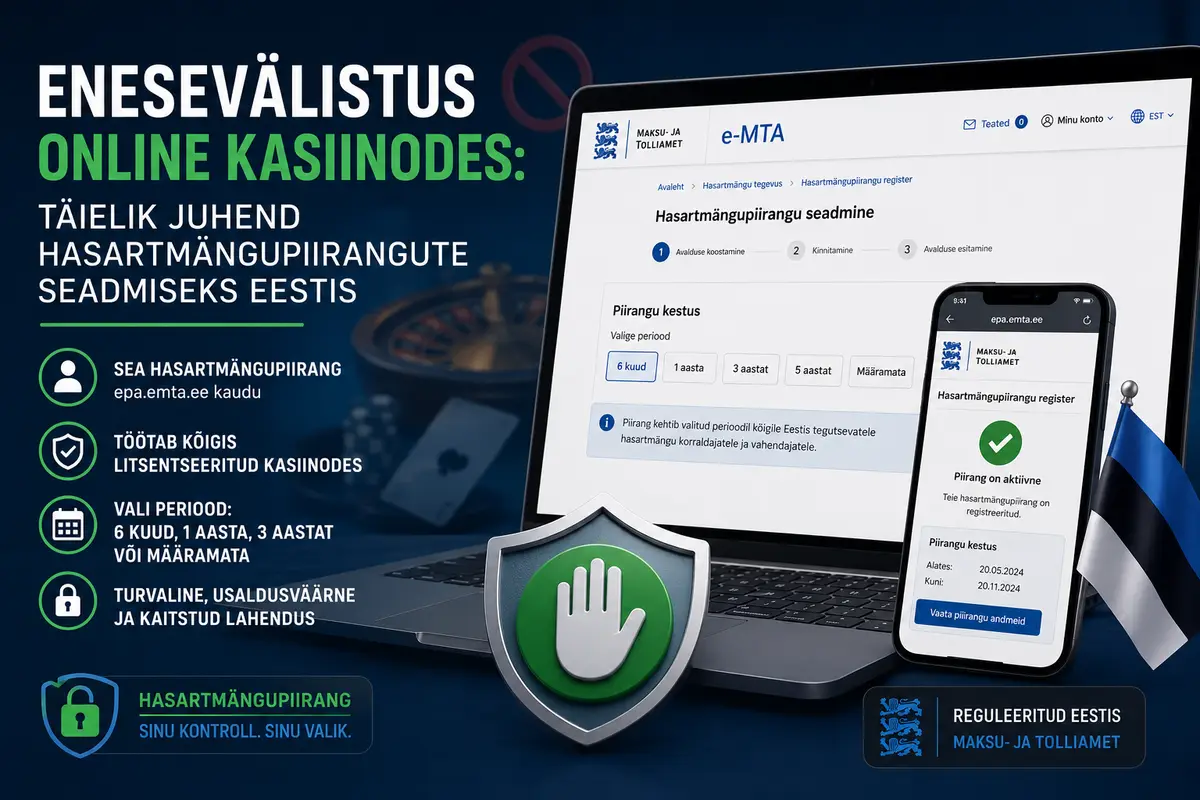
Self-exclusion at online casinos: a complete guide to setting gambling restrictions in Estonia
Online gambling in 2026 develops faster than ever. A modern Estonian online casino offers a registration-free gaming experience in seconds, where an instant deposit creates access…
Gambling online in 2026 develops faster than ever before. A modern Estonian online casino offers a registration-free gaming experience that happens in seconds, where an instant deposit creates access to thousands of games. Whether it's an innovative fast casino, a real-time live casino or an optimised mobile casino, entertainment is just one screen tap away. Competition on the market is fierce, and well-known game providers constantly fill operators' selections with new games, amplified by an enticing welcome bonus, a juicy deposit bonus or hundreds of free spins.
Although most players enjoy slots and table games in moderation, digital accessibility and the fast pace of games can lead to a loss of control. When casino games cease to be an innocent pastime and start affecting financial stability or everyday life, it's time to take a radical step. Responsible gambling also means the skill of pulling the brake at the right time. In this article we thoroughly examine self-exclusion — the legal and technical process by which a player can completely isolate themselves from gambling. This guide is created for Estonian players looking for a reliable and durable solution to limit gambling, explaining how the operator-based block and the state HAMPI register work.
Quick summary
- Definition: self-exclusion is a process in which a player voluntarily bans themselves from gambling either at a specific operator or centrally across the country.
- Two main ways: operator-based account closure straight from the casino settings, or state registration in the HAMPI register.
- Irreversibility: a correctly formalised self-exclusion or state restriction can't be cancelled under any conditions before the chosen deadline passes.
- Money return: the real-money balance is transferred via customer support to your bank account, but an active casino bonus or free spins are lost immediately.
- Regulation: all legal platforms with an EMTA licence must fulfil self-exclusion requests in real time and without delay.
What is self-exclusion at online casinos?
What is self-exclusion?
Self-exclusion is an official tool of responsible-gambling policy that allows a player to legally and technically oblige gambling operators to block their access to their player account and gambling services for a predetermined period of time.
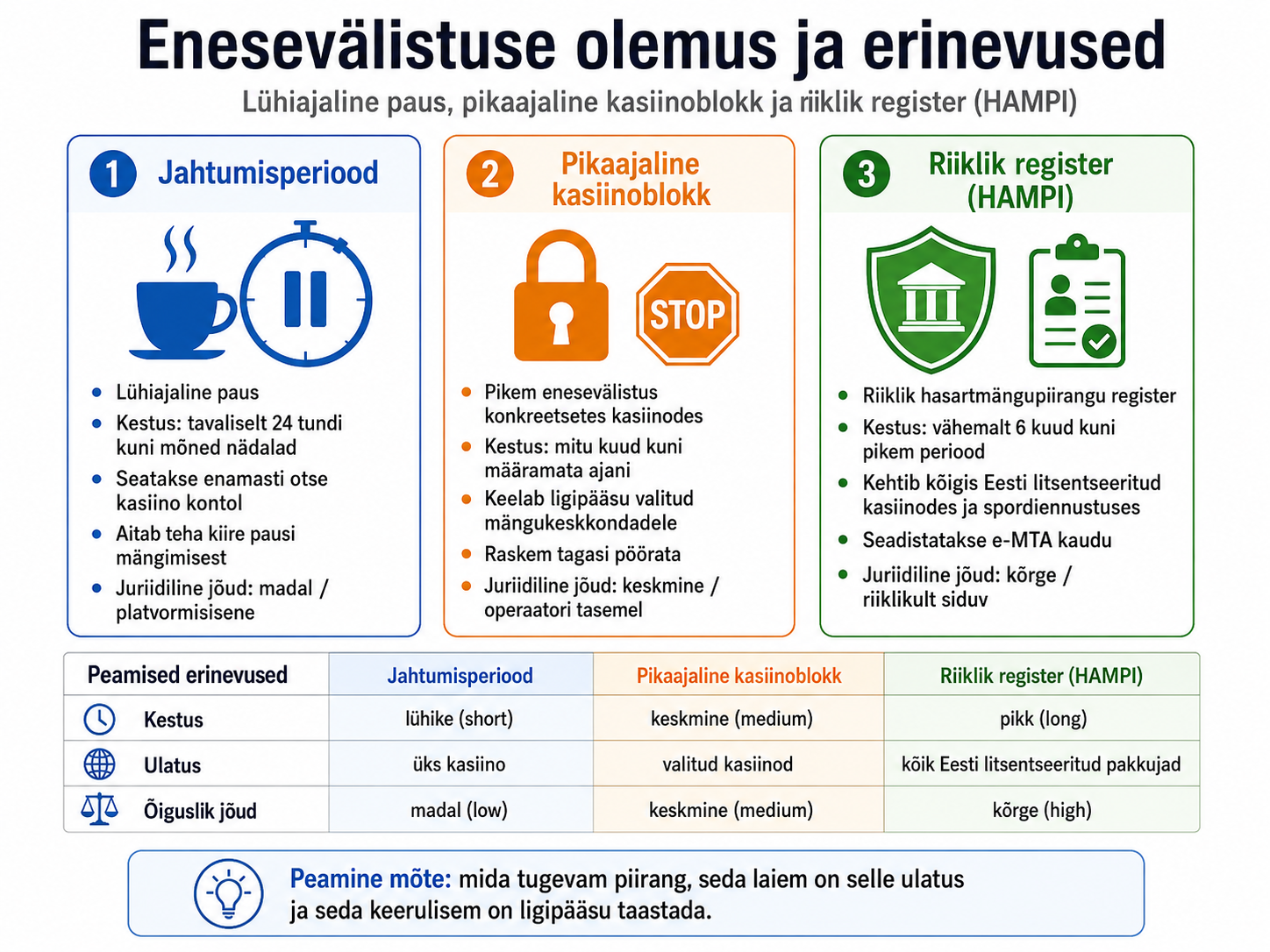
This measure differs from an ordinary temporary account suspension or "cool-off period". Self-exclusion is aimed at solving a long-term problem, and its main feature is its binding nature — once the restriction is activated, neither the player nor the casino's customer support has the right to cancel it before the deadline.
It's a psychological and digital barrier. Since gambling addiction is characterised by impulsive decisions, self-exclusion takes away from the player the technical ability to place bets at exactly that critical moment when self-control is lost.
How does self-exclusion work in practice?
The basis of self-exclusion's operation is strict identity verification. In the modern iGaming industry anonymous betting is ruled out, which makes the blocking systems exceptionally effective.
Linking personal data in the system
When you activate self-exclusion, it's not simply your username that's closed — your unique personal data (personal ID code, e-mail address, phone number and bank accounts) is entered into the casino's internal blacklist.
Automatic block at login and payments
As soon as the system has registered the data, the following rules apply:
- Blocking login: if you try to enter your credentials or log in with an ID-card/Smart-ID, the platform displays a message that the account is closed due to self-exclusion.
- Automatic detection at fast casinos: since the fast-casino model is based on immediate in-bank identification (for example via Trustly, Zimpler or Brite), your personal ID code is checked right at the moment of making a payment. If you have an active exclusion, the bank link is rejected and the deposit is interrupted.
- Halting marketing materials: the law obliges casinos to remove excluded persons from their newsletter, SMS-notification and personalised bonus-offer lists to avoid artificially creating a gambling impulse.
Different levels of self-exclusion in Estonia
Estonian players have the luxury of using one of the best-regulated gambling environments in the world. Self-exclusion can be applied at two different levels depending on the severity of the problem.
A comparison of self-exclusion levels in Estonia
| Attribute / Level | Operator-based self-exclusion | State self-exclusion (HAMPI) |
|---|---|---|
| Scope | Applies only at one specific casino or the brands of the same group. | Applies centrally at all casinos with an EMTA licence. |
| How to set it up? | From the casino account settings or by writing to customer support. | In the Tax and Customs Board's portal (e-MTA) digitally. |
| Selectable periods | Usually 24 hours to 5 years, or for an indefinite time. | Strictly fixed by law: 6 to 36 months. |
| Marketing ban | Stops a specific brand's offers and newsletters. | Legally prohibits all targeted gambling advertising in Estonia. |
| Cancellation | In some cases possible after submitting a long request and consideration. | Impossible. Can't be cancelled before the marked date arrives. |
Step-by-step guide: setting up operator-based self-exclusion
If you want to remove yourself from just one specific casino (for example because that casino's casino games or offers excite you too much), follow this guide.
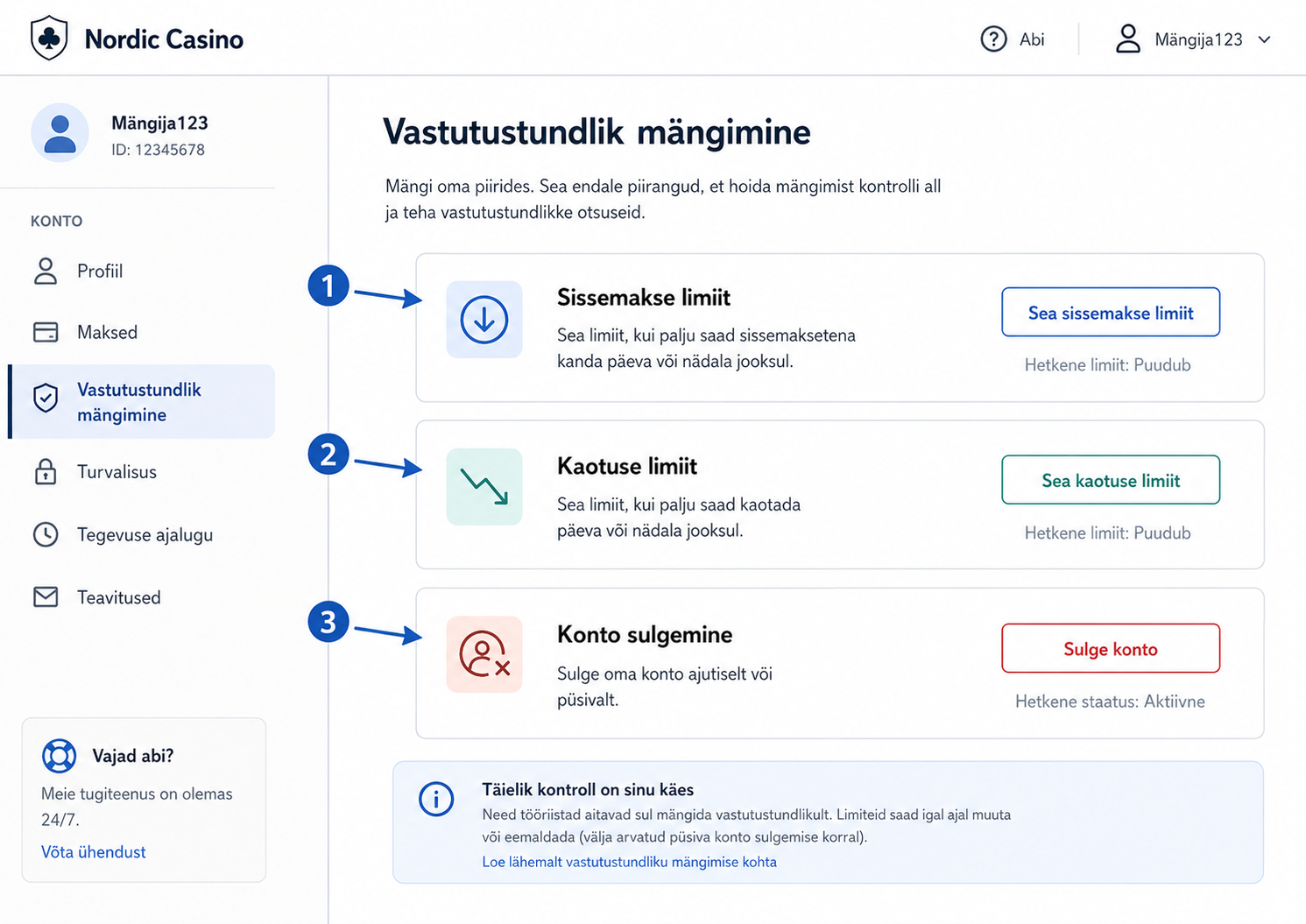
How to set a restriction via the casino account
- Log into your casino account: entering the portal.
Open your preferred Estonian online casino and perform the usual login or authentication via a bank link.
- Navigate to account settings: find the responsible-gambling section.
Click your profile icon and look for options like "My account", "Settings" or directly "Responsible Gambling".
- Choose the self-exclusion tab: set the block's length.
Choose from the options "Self-exclusion" or "Account closure". The system offers you a choice of time period (e.g. 1 month, 6 months, 1 year or permanent closure).
- Confirm your decision: final verification.
The casino displays a warning window explaining that pending bets and bonuses may be voided. Press the "Confirm" button or enter your password to activate the decision.
- If needed, send an e-mail: the customer-support alternative.
If you can't find the corresponding button in the account settings, you have the right to send the casino's official customer support an e-mail with the content: "I wish to make a self-exclusion for my personal data [Your Name and personal ID code] for a period of [X months]." A licensed operator is obliged to fulfil this manually.
State self-exclusion: the HAMPI register and the Tax and Customs Board
If closing accounts at individual casinos doesn't help and the player constantly opens new accounts on other pages, the only foolproof solution is a state centralised restriction. In Estonia this system is managed by the Tax and Customs Board, and the official database is named the HAMPI register (the list of persons with a gambling restriction).
How does the HAMPI register work?
When you enter yourself into the HAMPI list, the restriction becomes active in real time. Every time someone tries to enter some Estonian online casino or step into a land-based gaming hall, the operator's information system makes an automatic background query to the EMTA database. If the query finds your personal ID code on the list, your entry is immediately blocked.
The peculiarity of the legally set deadlines
Unlike operator-based rules, the HAMPI restriction periods are laid down by law. You can choose a restriction in the range of 6 to 36 months.
Expert warning: the HAMPI register's restriction is absolute. It can't under any circumstances be cancelled before the end of the full period you chose — not by withdrawing the application, not with a medical certificate, not by complaining to EMTA. The system is designed to be emotion-proof.
What happens to my money, account and bonuses after exclusion?
One of the main worries before self-exclusion concerns the fate of the funds left in the account. Here the licensed market protects the player completely.
Withdrawing real money
The casino has no legal right to keep your personal real money. Since you can no longer log into the account yourself after activating the exclusion, the rules are as follows:
- If it's an ordinary casino, you must write to customer support. They verify your identity and carry out manual withdrawals to your bank account within 1-3 business days.
- If you used a fast-casino platform, the system often tries to make an automatic money withdrawal back to your bank account as soon as the account is locked.
Casino bonuses and free spins
With bonus funds the story is different. If you had an active welcome bonus or deposit bonus whose wagering terms were unmet, then these are cancelled. All free spins left in the account also lose their validity. Self-exclusion cancels loyalty points and campaigns, since you've voluntarily given up further consumption of the gaming service.
Pros and cons: a comparison of self-exclusion methods
Self-exclusion from gambling has its advantages and disadvantages that analysts recommend weighing before making a decision.
Pros (advantages)
- Immediate stopping of the impulse: gives the brain the necessary pause to free itself from the dopamine cycle.
- Financial protection: rules out the risk of losing money meant for sustenance, rent or covering loans.
- Complete privacy: HAMPI data is secret. Neither an employer, a family member nor a bank sees your name in this register (the bank assesses creditworthiness only on the basis of your account statement, not the register).
- Legal reliability: a safe casino with an EMTA licence ensures the real-time protection of your data and is subject to strict state control.
Cons (disadvantages)
- Inflexibility: if you make a mistake and choose too long a period (e.g. 3 years) in a situation where you only wanted a short pause, the decision can't be reversed.
- The black-market danger: self-exclusion doesn't prevent you from visiting unlicensed foreign websites that operate outside Estonian jurisdiction.
Common mistakes and how people try to sneak around self-exclusion
One manifestation of addictive behaviour is attempts to sneak around the created restrictions in a moment of weakness. Experts know these patterns well.
Opening an account in other people's names
The most common and dangerous mistake is trying to play with a family member's or friend's data.
Warning: creating an account with another person's data and using someone else's bank account is a grave rule violation that qualifies as identity theft. Every safe casino will detect such fraud no later than the winnings-payout and document-check phase. The result is permanent account freezing and confiscation of all winnings with no right of appeal.
Moving to unlicensed casinos
Players who have entered themselves into the HAMPI register often end up, via search engines, on foreign pages that lack an Estonian licence. These operators do allow registration, but the player exposes themselves to enormous danger: there's no control over fairness, withdrawals can be voided out of thin air, and the player has no state protection or support in the event of disputes.
Third-party software and blockers (Gamban, BetFilter)
Since state registers cover only the local licensed market, for global protection it's recommended to use special software that blocks gambling at the device level.
This method excellently complements the HAMPI register, creating double protection for both the smartphone and the desktop computer.
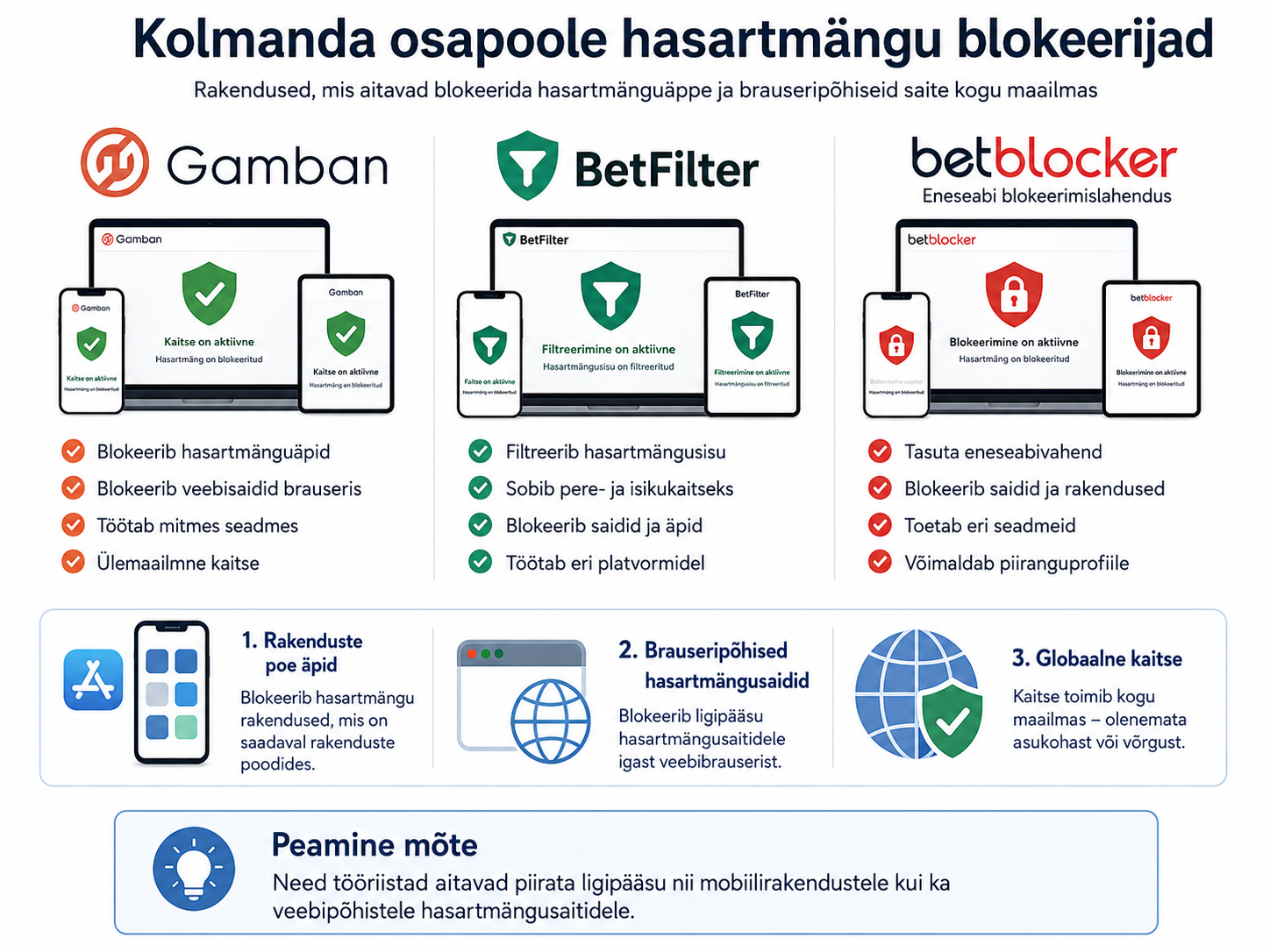
An overview of the best gambling blockers
| Software name | Supported platforms | How does it work? | Price and availability |
|---|---|---|---|
| Gamban | Windows, macOS, Android, iOS | Blocks tens of thousands of gambling sites and apps globally at the device level. | Paid (monthly), but often free through help organisations. |
| BetFilter | Windows, Android, iOS | Software specially created against gambling addiction that doesn't let itself be easily removed from the device. | Paid licence. |
| BetBlocker | All common operating systems | A non-profit and completely free web blocker that can also be set up in parental-control mode. | 100% free. |
Checklist: are you ready for self-exclusion?
Before you take the decisive step, go through this short self-check to choose the strategy that suits you best.
The self-exclusion readiness checklist
- [ ] 1. Do you regularly feel an irresistible compulsion, after a loss, to immediately make a new deposit to win back the money (chasing losses)?
- [ ] 2. Have you caught yourself thinking that you hide the time or sums spent on gambling from your loved ones?
- [ ] 3. Have you tried to set daily limits at the casino but cancelled or raised them the moment emotion surges over?
- [ ] 4. Are you ready to come to terms with the fact that after confirming the exclusion you won't be able to bet at any Estonian casino for several months, even if the final match of your favourite sport is taking place?
- [ ] 5. Have you made sure the real money in your account has been withdrawn, or are you ready to wait for its return via customer support manually?
Frequently asked questions (FAQ)
What is self-exclusion and how does it differ from account deletion?
Self-exclusion is an official and legally binding gambling break that can't be cancelled before the deadline. Ordinary deletion or closure of an account is more flexible and often lets the customer reopen the account at any time by simply writing to customer support, which doesn't offer sufficient protection in the case of an addiction risk.
Can self-exclusion be cancelled if I change my mind?
No. Once self-exclusion is correctly activated (either at the casino or in the state HAMPI register), cancelling it before the appointed date arrives is strictly excluded by law. This rule protects the player from impulsive decisions in the phase of regret.
What is the HAMPI register and how do you get into it?
The HAMPI register is an electronic list of persons with a gambling restriction, maintained by the Tax and Customs Board. You can enter yourself there free in the e-MTA environment, choosing a restriction length of 6 to 36 months. The restriction applies centrally to all Estonian licensed operators.
Does self-exclusion apply at fast casinos too?
Yes, completely. Since every fast casino identifies the player's identity in real time through a bank link (Smart-ID, Mobiil-ID or ID-card) before allowing a deposit, the system automatically checks the personal ID code against the HAMPI register and the casino's internal data, immediately blocking restricted persons.
What happens to the money left in my account after self-exclusion?
Your real-money balance is returned to you in full. Since you can no longer log into the account yourself, you must contact the casino's customer support by e-mail, who will carry out manual withdrawals straight to your personal bank account. Your bonuses and free spins, however, are cancelled.
Will the bank find out that I've excluded myself from gambling?
No, banks have no access to the state HAMPI register or the casinos' internal databases. The bank assesses your financial behaviour and mortgage capacity only on the basis of the real transactions in your account statement. Self-exclusion actually cleans your account history of casino signatures.
Does self-exclusion block foreign online casinos too?
No, operator-based restrictions and the state HAMPI register work only for those operators that have an official EMTA licence. To block foreign, unlicensed offshore sites you must use special device-level software such as Gamban or BetBlocker.
Can I make a self-exclusion for my friend or family member?
No, under the Gambling Act only the person themselves can submit a self-exclusion application or a HAMPI register request. On behalf of another adult person, without their digital authentication, a restriction can't be set, except when it's a court-appointed official guardian.
How long a self-exclusion period should I choose?
If you feel that control over gambling is lost, experts recommend choosing a minimum 12-month period. Shorter pauses (e.g. 1 to 6 months) may not be enough to break the addictive dopamine cycle and change durable life habits.
Does self-exclusion stop the receipt of advertising messages from casinos?
Yes. By law licensed casinos are obliged to immediately remove persons who have made a self-exclusion or HAMPI registration from their marketing channels. They can no longer send you SMS messages, e-mails or targeted bonus offers.
Related topics
Conclusion and the expert's final word
The modern Estonian online casino landscape offers exceptionally convenient and fast access to entertainment. Technological innovations ensure that casino games run smoothly on any device, the best game providers create exciting visual content, and fast withdrawals make receiving winnings convenient. But given the specifics of gambling, it's important to remember that it's pure entertainment, not a way to earn money.
When you feel that the pleasure of gambling is replaced by stress, concealment or financial problems, self-exclusion is the strongest and most responsible step you can take for the sake of your wellbeing. Whether it's a short-term account closure straight from the settings or a long-term centralised restriction through the state HAMPI register — this decision creates a safe space and time for you to restore control over your life and finances.
Don't be afraid to ask for help and set restrictions. The licensed and safe casino environment is created to support you in these decisions, and the Tax and Customs Board ensures that the barriers you set stay unshakeably in place. Play consciously, know your limits and, if needed, take a step back — your future and peace of mind are worth it.
Key takeaways: self-exclusion as a responsible gambling tool
Self-exclusion is one of the most effective ways for an Estonian player to keep their gambling behaviour under control, and the core message of this guide is simple: setting limits in an online casino is not a sign of weakness but a mature, forward-looking decision. The moment betting starts to affect your budget, sleep, relationships or mood, it is time to use the responsible gambling tools a casino provides and, if needed, the national gambling ban. The sooner you put gambling limits in place, the lower the risk that a fleeting emotion leads to impulsive decisions and chasing losses that have already gone.
It helps to understand that self-exclusion in Estonia works on two levels. First, every licensed online casino lets you set personal limits: deposit limits, loss limits, session time limits, and a temporary or indefinite account closure. Second, the state offers a nationwide ban through the register of gambling restrictions maintained by the Estonian Tax and Customs Board (EMTA), which applies at the same time across every gambling venue and online casino licensed in Estonia. The national ban is the stronger option because it does not depend on the goodwill of a single operator and cannot be reversed with a single mouse click.
The most common mistakes are postponing limits until the problem is already serious, setting limits that are far too generous, and cutting short a so-called cooling-off period the moment the urge returns. Many players underestimate how quickly modern registration and instant deposits allow them to start playing again. For that reason it is wiser to choose a longer period rather than a short one, to set limits lower than feels comfortable at first glance, and to activate restrictions with a clear head rather than in the heat of the moment.
What should you do next? Begin with an honest assessment of your current play: how much money and time it consumes and how the experience leaves you feeling. Then set concrete limits as a specific figure rather than a vague intention. If individual casino limits are not enough, add yourself to the EMTA register, which covers the entire licensed Estonian market. Talk to someone you trust if you wish, and remember that asking for help is a sign of strength, not shame.
Finally, a brief responsible gambling reminder: gambling in Estonia is permitted from the age of 21, it is entertainment rather than a source of income, and you should only stake money you can genuinely afford to lose. If you feel control slipping, reach out for free, confidential counselling and support, and consider self-exclusion today.
Responsible gambling and finding support
Setting limits is a process, not a one-time act. Review your limits regularly and tighten them when needed. If the game no longer brings enjoyment or begins to cause anxiety, that is a clear signal to take a break. Free and confidential counselling is available in Estonia, and the national gambling ban is always open to anyone who wants to step away from gambling entirely. Play consciously, and play responsibly.
Related terms: self-exclusion — meaning and process and responsible gambling.